Showing posts with label travel. Show all posts

Monday, November 25, 2019

New interview with writer Dave Tomlinson


Writer Dave Tomlinson is back in the hot seat. Today he’s chatting with me about his non-fiction sport’s book, Days of Miracle and Wonder.

Welcome back to Reviews and Interviews, Dave. Please tell us a little bit about yourself.
My name is Dave Tomlinson. I’m from New Zealand and now living in Brisbane, Australia. My life passions are travel, outdoor adventure, sport and writing. After writing the budget travel guide Travel Unravelled I then documented my travel stories in Around the World in 80 Tales (my interview on this blog about this book is here). I blog about my travel and assist other travellers on my Step Ahead Travel website. It’s my dream to eventually travel 100 countries and go to every continent on the planet.

My first sports book Days of Miracle and Wonder describes 25 of the most incredible sporting victories brought about by amazing comebacks and painful chokes. This was followed by ‘Unlevel Playing Fields’ which tells the dramatic stories behind 25 of the greatest sporting controversies. The latest publication in this fascinating series ‘Excellence in Motion’ relates the courage, respect and sacrifice displayed in 25 of the finest acts of sportsmanship.

Please tell us a little more about your newest release.
The thrill of victory, agony of defeat and human drama of competition are the fundamental allure of sport. Its glorious unpredictability is truly captivating and nothing captures our imagination more than a contest which suddenly comes alive after the result appeared to be a foregone conclusion. Whether it's the anguish of a choke or the brilliance of a comeback, Days of Miracle and Wonder captures these moments and tells the unique stories behind 25 of the most incredible sporting victories.

What inspired you to write this book?
The inspiration for writing this book came from Steven Bradbury's gold medal in short track speed skating at the 2002 Winter Olympic Games. His astonishing story resonated with me because it captures the glorious unpredictability of sport. I love an exciting comeback or underdog victory as much as anyone! And as I pondered Bradbury’s remarkable achievement, I began to think about other implausible victories across the sporting spectrum.

My mind flashed back to watching Jana Novotna lose the 1993 Wimbledon final to Steffi Graf. Six years later, I will never forget the dark shadow cast across New Zealand when the All Blacks lost their World Cup semi-final to the unfancied French side. The same year, South Africa snatched defeat from the jaws of victory against Australia in the 1999 cricket World Cup semi-final. In yet another heartbreaking disappointment, the Kiwis lost the 2013 America's Cup to Team USA after being on the brink of victory, time and again.

Brazilian soccer legend Pelé once said "The more difficult the victory, the greater the happiness in winning." The glory of winning and the ignominy of losing against the odds have given us many unforgettable sporting moments. Over the years we’ve seen courage and brilliance, but also honest displays of human frailties. It’s my hope that I’ve captured the passion and emotion of each occasion rather than just the results.

What’s the next writing project?
After completing Unlevel Playing Fields and Excellence in Motion, I watched in admiration as Tiger Woods came back from the depth of personal transgressions and crippling injury to win the 2018 Tour Championship and then the Masters in 2019. Making a career comeback in sport is one of the most difficult things to do with dignity and there is every chance of failure. It became the inspiration for the fourth book in my sporting series.

Legendary American football coach Vince Lombardi is widely recognised as one of the greatest leaders in the history of sport. Among his many famous quotes, he once said: "The real glory is being knocked to your knees and then coming back. That's real glory. That's the essence of it." He knew what it meant to make a comeback and captured in those words the triumph that sportspeople experience when they've done it successfully. And he had given me my book title.

The Real Glory celebrates the sportspeople who have shown exceptional courage and dedication. They went beyond what was expected of them in a triumph of the human spirit. Nothing is assured in the cut and thrust of professional sport, but to those who are prepared to take the risk, the reward is a unique glory. Sporting legends are not hammered into shape on the anvil of results alone; they come from the way those results were achieved, including the sacrifices made just to be in the contest.


What is your biggest challenge when writing a new book? (or the biggest challenge with this book)
One of the biggest challenges in writing my books is structuring each chapter. It’s a challenge that I enjoy because I want to tell the story in the best possible way. I want to strike a balance between providing readers with relevant facts and an interesting narrative. This often involves beginning at a certain point, going back in time and then coming forward in time to complete the loop. I also find the final paragraph or two a good challenge. I don’t like to finish anything abruptly and leave an unpolished surface. I think concluding something well is an important aspect of any writing.

If your books require research – please talk about the process. Do you do the research first and then write, while you’re writing, after the novel is complete and you need to fill in the gaps?
Good question. I tend to do most of my research before I begin writing. By doing that, it helps me plan how I’ll write the chapter. I have a Word document called ‘Notes’ which is like a scribble pad. It enables me to jot down important points and ‘landmarks’ that I need to pass. I often find however, that as I get into my writing, further research is required. I’ve spent many hours using Google to find relevant websites from which to extract the information I need. More notes are added until the gaps are sufficiently filled and I can complete what I’m doing.

What’s your writing space like? Do you have a particular spot to write where the muse is more active? Please tell us about it.
I find the atmosphere at the public library the most conducive to good writing. It’s a relaxed space with good lighting and being surrounded by other people working, reading and studying is an incentive for me to concentrate well. I’ve done some writing at home but I tend to get distracted more easily. Wherever I am though, I find coffee always helps with creativity and focus!

What authors do you enjoy reading within or outside of your genre?
I enjoy reading sporting biographies and my favourite fiction authors are Dan Brown, Lee Child and J.D. Robb.

Anything additional you want to share with the readers today?
A book is a gift you can open again and again. Enjoy your reading!

Thank you for coming back to Reviews and Interviews!


Wednesday, May 8, 2019

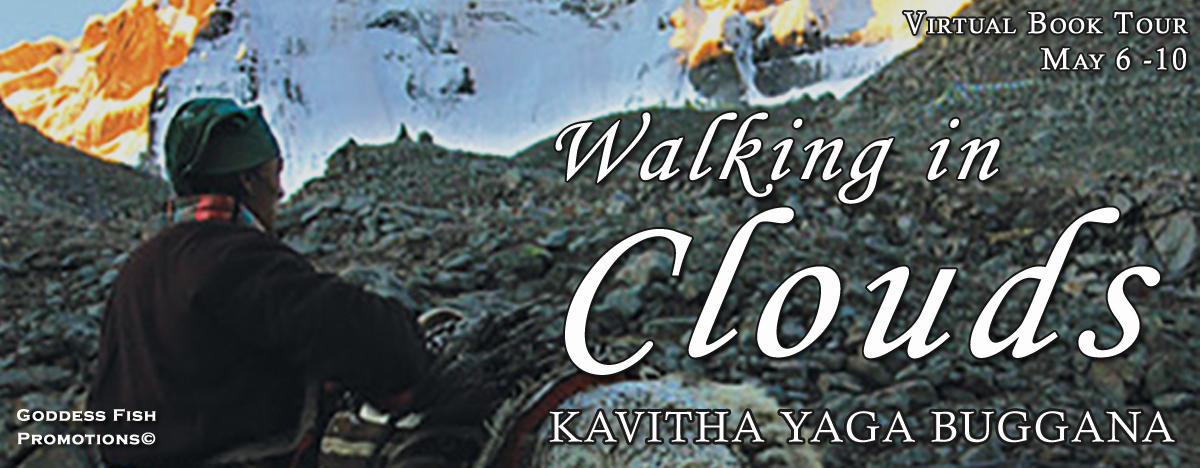
Interview with memoirist Kavitha Yaga Buggana


My special guest today is Kavitha Yaga Buggana to chat about her travel memoir, Walking in Clouds, A Journey to Mount Kailash and Lake Manasarovar.

During her virtual book tour, Kavitha will be awarding a $25 Amazon or Barnes and Noble (winner’s choice) gift card to a lucky randomly drawn winner. To be entered for a chance to win, use the form below. To increase your chances of winning, feel free to visit her other tour stops and enter there, too!

Welcome, Kavitha. Please share a little bit about your current release.
My travel-memoir, Walking in Clouds, A Journey to Mount Kailash and Lake Manasarovar, is based on my trip to a mysterious mountain and a beautiful, tranquil lake in Tibet.  It’s a journey spanning ancient monasteries and verdant Himalayan pine forests, freezing slopes and bright sunlight, exhaustion and joy, sacrifice and gratitude.

Kailash and Manasarovar are deeply sacred to Hindus, Buddhists, and others and as an atheist walking in these sacred spaces, I examine my judgements about faith. ‘Walking in Clouds’ is also about people - my cousin, who went on this journey with me, our fellow travellers from the world over. The book examines faith, rationality, myth, Tibet’s deeply troubled politics, the friendships formed, and the extraordinary landscapes of these places.

Interspersed with striking photographs and a rich storytelling style, the book is ultimately a mediation on beauty, faith, friendship, place, and journey, both the outer and inner. 

What inspired you to write this book?
For my cousin Pallu and me, the trip to Kailash and Manasarovar was an adventure we had dreamed of since we were schoolgirls. I had no intention of writing about this journey, but a year after my trip, I started working on a brief account of the journey. The more I wrote, I realized, the more there was to write about the wonder, tranquility and awe-inspiring beauty of the mountains and the enduring faith of the people who live in there. That’s how my book was born.


Excerpt from Walking in Clouds:
In this excerpt of Walking in Clouds, our group has reached the first campsite at the foothills of Mount Kailash. Fellow travelers Sperello and Jeff have both gone further up the slopes while the rest of us are at the campsite with our guide, Chhiring.

A little while later, the tall figure of Sperello descends down the path.
‘Where’s Jeff?’ Chhiring asks.
‘He should be down soon,’ Sperello says, his face pensive. ‘Something happened to Jeff in the mountain.’
When Sperello started up the slope, Jeff had already set out. With each step, Jeff felt that he was moving forward but the mountain was not getting any closer. Another step, Jeff told himself, one more step. But it was no use; the mountain seemed as distant as it had always been. At one point, Jeff stopped; he could not walk any further. As he gazed at the colossus of rock before him, he was shaken by a feeling that the mountain was rising from below, as if it were moving, growing from the earth to the sky. An inexplicable emotion coursed through his body, moving him so profoundly that he fell to his knees. Sperello, who was taking photos in the vicinity, asked if everything was all right. But Jeff could not speak. Still kneeling, he shook Sperello’s hands.
‘I will never forget it,’ Jeff tells us later. He can’t seem to explain what happened to him at that moment.
On his travels, Jeff is always an observer. He is a photographer, a chronicler of journeys, and a consumer of other cultures and geographies. But that day on the mountain, everything changed. The lens was forgotten. The need to observe and the process of thought vanished. Jeff was no longer an eye, watching and noting; he was being and doing and feeling. The same man who, a few days ago, had found it odd and eccentric that Mariene could meditate on the river bank had been overcome by an immensity of emotion that had brought him to his knees. He had been felled by a deeply spiritual experience that belonged only to him, and to the mountain.
The experience altered Jeff’s understanding of the world and of himself. The effect this vision had on him and the questions it raised for him were a profound kind of truth. Since ancient times, mystics of all religions have strived to reconcile their spiritual experiences with the parameters of the physical and material world. Many have come to understand that while reality and truth are not always the same, they do not necessarily oppose or preclude one another. The myths of Shiva, the lake and the mountain, Buddhist stories and visualizations, the feeling of a mountain rising: none of these need be literal in order to be considered truthful. Such moments simply point to a truth as complex as the people who seek to understand them.


What exciting story are you working on next?
I’m working on a book of short stories. They are all set in India, but that’s about the only thread that connects them. The stories range from the light-hearted (such as a story about a young man who wants to buy milk for coffee and finds that everyone is gripped by the possibility of a milk miracle) to the introspective (such as the story of a woman and a talking bird which discusses reality versus perceptions of reality) to the socially sensitive (such as the story of a missing servant girl, which is a commentary on life opportunities and economic circumstances).

When did you first consider yourself a writer?
After I published a couple of essays and short fiction in literary magazines and in newspapers.

Do you write full-time? If so, what's your work day like? If not, what do you do other than write and how do you find time to write?
I don’t work full-time any more. When I’m not writing, I take care of family, I read, I volunteer.

What would you say is your interesting writing quirk?
I keep mussing with my hair when I’m thinking deeply about issues related to writing. At the end of the day, my hair looks like a nest.

As a child, what did you want to be when you grew up?
Pippi Longstocking, the feisty redhead in the popular children’s books by Astrid Lindgren.


Anything additional you want to share with the readers?
Walking in Clouds received some great reviews in the Indian press. Here are some quotes:

‘[Kavitha’s] mix of Oriental-Occidental wisdom can dot the readers’ minds with the spray of sparkling Himalayan stars.’
Aman Nath in Outlook Traveller Magazine, March 2019.

‘This book is the most enjoyable I have read on the Mountain and the Lake.’
Deb Mukharji, Author, Kailash and Manasarovar: A Quest Beyond the Himalaya

‘Walking in Clouds is not only [about] two women's extraordinary journey to the mountains, but rather an account where the author has captured every moment of surprise, shock and despair in detail.’
Priyanka Richi, The Newsminute, 31st March, 2019

Links:

Thank you for being a guest on my blog!
Thanks for having me!


Monday, June 5, 2017

Interview with novelist David Smith

Author David Smith helps me launch a new week at Reviews and Interviews. We’re chatting about his new coming of age travel novel, Letters to Strabo.

Welcome, David. Please tell us a little bit about yourself:
I live near the south coast of England with my wife and three teenagers. Writing is my relaxation as by day I’m the Chief Financial Officer for a British blue chip public company. I love travel and have worked in the UK, Switzerland, the US and Turkey.

I’ve published four novels all with strong themes of romance and intrigue. My first novel Searching For Amber has been described as “A powerful and notably memorable debut” with a review describing it as “masterly and confident” and another as “Extraordinary, poetic, enchanting, sublime”. Letters to Strabo has been described as “Rich and intriguing, vivid and gripping”.

Please tell us about your current release.
Letters to Strabo is a coming-of-age novel that will appeal to lovers of literary fiction, good travel writing and the classics.
Adam Finnegan Black, or ‘Finn’, an innocent young American who is insatiably curious about life, made a promise to his mother before she died: To find out what really happened to his father…
His ambition is to be a travel writer, like his heroes: Mark Twain, Ernest Hemingway and the ancient Greek ‘father of geography’, Strabo. His journey of discovery takes him through the radiant literary, cultural and picturesque landscape of the Mediterranean.
Following his heart and inspired by Letters to Strabo, written by his long-distance pen-pal Eve, Finn gradually learns more about himself but also about the woman he hopes will one day become his wife.
Funny, provocative, disarmingly honest, Finn’s story captures the excitement and mistakes of youthful energy and proves ultimately life-affirming in the emergence of new hope from personal tragedy.
What inspired you to write this book?
My first idea for Letters to Strabo came from the memory of a trip I made twenty years ago to Olana, the amazing Catskills home of the painter Frederic Edwin Church. It was a truly stunning experience. Both the exterior but more importantly the interior of this Moorish extravaganza produced a complete sensory overload that day that has stayed with me ever since. I’ve long wanted to write a love story that starts with a visit to this house by a young writer, but for ages I didn’t have a good starting point. That was until I discovered that Church’s wife had given him a copy of the Strabo’s Geographica for Christmas 1879: they’d named Olana after a place he described. Shortly afterwards they were visited by Mark Twain, who of course wrote about this travels in Europe in The Innocents Abroad. The die, as they day, was cast.

What exciting story are you working on next?
I am working on a YA fantasy, which is a reworking of the classic Dodie Smith novel I Capture the Castle told through a seventeen year-old apprentice wizard called Cassie Scott.

When did you first consider yourself a writer?
I wrote poetry when I was younger, but for about twenty years after that wrote little and tried to learn to paint. Having concluded (eventually) that I was talentless as a painter, I decided to try writing again. My first book: Searching For Amber was a love story set in a place that my wife and I used to visit a lot before we had children. It took me over five years to bring to completion. Since then I’ve accelerated, now writing about one book a year.

Do you write full-time? If so, what's your work day like? If not, what do you do other than write and how do you find time to write?

As a CFO my day-job is pretty full-on, but I find writing a relaxing right-side brain hobby. I get most of my ideas in the early-morning and, if I remember to, note them down. I usually need to have a quiet space of 2-3 hours at home to write creatively, usually at weekends. But I also travel quite a bit, so reading other novels and editing are something I can do when I’ve put the work papers away in a snatched hour or so on a train or between planes!

What would you say is your interesting writing quirk?
I have a bad habit of inventing very complex structural frameworks. For instance the characters in my second book Death in Leamington are the 14 characters represented in Elgar’s Enigma variations and Letters to Strabo is structured around the 17 chapters of Strabo’s Geographica

As a child, what did you want to be when you grew up?
Definitely an astronaut as I was eight when Apollo 11 landed on the moon. I still have an ambition to be the first economist in space but it will probably never happen (i.e. if you strung all the economists in the world end-to-end they’d never reach a conclusion).

Anything additional you want to share with the readers?
In addition to schoolboy French, German and Spanish, I have also learned Swiss-German Schwyzertüütsch and Turkish for business and pretended to learn Cornish: an lavar coth yw lavar gwyr, byth dorn re ver dhe’n tavas re hyr mes den hep tavas a-gollas y dyr (still true the ancient saw will stand too long a tongue too short a hand, a tongueless man though lost his land.)

Links:

Thanks for being here today, David.

Monday, February 8, 2016

Special excerpt from Good Morning Diego Garcia by Susan Joyce


Today’s post is just one of several blog stops for Susan Joyce as she tours her new travel-adventure memoir, Good Morning Diego Garcia

During her virtual tour, Susan will be awarding a $20 Amazon or Barnes and Noble (winner’s choice) gift card to a lucky randomly drawn winner. To be entered for a chance to win, use the form below. To increase your chances of winning, feel free to visit her other tour stops and enter there, too!

A little bit about Good Morning Diego Garcia:
When Susan and Charles receive a letter from Cyprus friends, now in Taiwan, they get a chance to help crew a sailboat from Sri Lanka across the Indian Ocean. They have no clue what to expect. Susan reminds Charles she isn't a good swimmer. He tells her a life jacket will do the trick, and convinces her it's the opportunity of a lifetime. A must-do travel adventure. They say goodbye to friends and family in sunny California, fly to New York and on to India, arriving the day the Indian government has issued a state of emergency. And then onto the boat, and into the ocean. In monsoon season. With no charts.

In this true-life travel adventure, Susan keeps a journal and record her bizarre thoughts and telling dreams. A real life thriller, Susan's monsoon-season journey is about discovery and spiritual realization—one dream at a time.


Excerpt from Good Morning Diego Garcia:
Ch 12

A powerful surge of energy flooded my body and relaxed me. It was a breakthrough as I became aware of a reality outside my perceived normal existence. The sea heard, answered me, and calmed. I experienced a moment of pure joy when I discovered the interconnections of nature and the universe around me. My epiphany.

This was not the first time I had felt supernatural powers surround me. I had experienced this also as a child when I sat out on a hot rock in the Arizona desert with my dog Brownie. We watched magic happen while we waited on a spaceship to collect us. My senses became so keen I could see rocks change as the wind brushed them.

I thought back to Cyprus and the long months I had spent in bed thinking and dreaming, bedridden in an attempt to have a healthy baby. Information seemed to flow then from a higher spiritual reality, and events that were beyond what could be explained by nature happened. Again and again.

As the sea stirred my senses, I became the curious, wide open-eyed child again, welcoming the power of magic

Examining these connections, I realized I had touched on a greater truth; the reality of how I fit into the bigger picture of life. The quieter I became, the more I could see and hear. Was it my imagination? Or was I experiencing a heightened awareness as a result of being in tune with nature. Floating in this immense ocean at eye level, gave me a new appreciation for how massive the universe is, and how small and insignificant a human is by comparison. A small speck in the full spectrum of life on earth.

I had traveled far and wide to find myself; to discover my core. My soul.


A little bit about the author:
Born in Los Angeles California, Susan Joyce spent most of her childhood in Tucson, Arizona and returned to LA as a young working woman. Inspired as a child by postcards from her globe-trotting great aunt, Susan left the United States at age 20 to see the world.

She planned on being gone for a year, but ended up living her 20s and 30s in Europe and the Middle East. As a Jill of all trades, she worked as a secretary, freelance writer, taught computer classes, wrote songs, and became an accomplished artist while writing her first children's book, Peel, the Extraordinary Elephant.

An award-winning author and editor of children's books, Susan's first adult book in her memoir series, The Lullaby Illusion--A Journey of Awakening is a travelogue of the politics of Europe, the United States, and Israel during a twelve year 'roller-coaster' period of her life and an adventure of survival through friends and sheer determination.

The Lullaby Illusion was awarded
* Readers' Favorite 5-Stars and the 2014 GOLD Medal Winner, Non-Fiction--Travel in the 2014 Readers' Favorite International Book Awards.
* Honorable Mention Prize Winner--2014 Stargazer Literary Prizes

Good Morning Diego Garcia, her second travel memoir, is about her adventure from India and across the Indian Ocean in monsoon season in 1975. Available for pre-order.


Stop in and say hello to Susan on Facebook.


a Rafflecopter giveaway