Thursday, February 9, 2017

Interview with writer Tommy Donovan about his coming-of-age memoir

Writer Tommy Donovan joins me today to chat about his coming-of-age memoir, The Rail: What Was Really Doin’ in the 60’s Bronx.

Bio:
Tommy Donovan grew up near the Amalgamated Cooperative Housing in the Van Cortlandt Park area of the Bronx. Coming-of-age during the turbulent and questioning 1960s helped shape his spirit of inquiry and critical thinking. He currently lives in Big Timber, Montana, with his life-partner, Dr. Kim C. Colvin. Tommy holds a doctorate in psychology from Pacifica Graduate Institute, and is a Faculty Fellow in the Honors College at Montana State University.

Welcome, Tommy. Please tell us about your current release.
This is my coming-of-age memoir that depicts the struggles of the son of an Irish immigrant growing up in an all-Jewish neighborhood in the Bronx, between the end of World War 2 and the shadow of the Holocaust, and the emergence of the turbulent 1960s. At home, I wrestle with family dysfunction, while in the streets I must navigate a world where being a goy (gentile) confers a hurtful, outsider status on him. Eventually, my life hangs in the balance as I struggle to not surrender to the pull of drug addiction while fighting to break free and flee the Bronx for good. My confrontation with these formidable obstacles, on my journey to manhood, takes place center stage at “The Rail,” where my allies and nemeses gather daily.

What inspired you to write this book?
This is my first book. I was compelled to write this because whenever my childhood friends and I have described our growing up, we consistently get amazed reactions and someone inevitably says, “Your stories should be a book.”


Excerpt from The Rail: What Was Really Doin’ in the 60’s Bronx:
There was one particular section of the fence that ran along Van Cortlandt Park South, that came to serve as each generation’s true north and the epicenter for all manner of social interaction – especially for the postwar baby-boomers. Directly in front of the park, this portion of the fence stretched east from the retaining wall to the asphalt pathway leading into the playground area, approximately 60 feet in length. When we were little, it was just part of the landscape demarcating the boundary between the street and the park, claiming no particular attention during our comings and goings. At that tender age, even if we noticed the older kids hanging out there it had little impact on us and even less interest. As we found ourselves inexorably thrust into our teenage years, this spot in front of the playground began to loom larger and larger in our lives and our imaginations as the place to be. This section of fence was known to everyone as, simply, The Rail.

* * * * *
I AM THE BASTARD SON of an immigrant Irishman. For this reason, and more that you will discover in the course of this memoir, I have had a difficult time locating home, trusting family, finding safe harbor in many of my intimate relationships. Yet between the years 1956-1972 (spanning the ages between five and twenty-one), home, family, and a place of safety were located in the Bronx. I found them not in my own house, but in the homes, schoolyards, playgrounds, and streets of a tiny, modern-day shtetl populated predominantly by Jews. Beneath the apparent incongruity of this statement – safety in the streets of the Bronx, family among people of a completely different religion, and home within others’ homes – a deep and abiding kinship revealed itself over the course of my childhood, a kinship with a place and the people who lived there that shaped decisively who I was then and who I am now. Indeed, this sense of kindredness has informed my entire life; during these tender and impressionable years, I learned how to trust, how to share, how to stand up for what I believe, and how to love.

The soil that nurtured this unlikely, lifelong bond with this place, with Jewish culture, and with the friendships forged there – many continuing to this day – was seeded by a variety of episodes, traumatic and elegant, painful and exquisitely loving. Mine was a coming of age in a peculiar time and place. Wedged between the nightmare of World War II and the thunderous, shattering Sixties, my coming of age awoke in me, and many of us, common rhizomatic stirrings to live beneath a sun different than the one we inherited. Pulled by an indescribable draw toward a deep mutuality, there arose a desire to band together in ways that would lift us beyond what the larger world offered as the apparently irreconcilable differences of ethnicity, class, gender, religion, and race. Our sensibilities were shaped by a nascent determination to defy a history of fear and the promise of more of the same and, instead, create something we imagined would be entirely new.


What exciting story are you working on next?
YA fiction based in Celtic Mythology.

When did you first consider yourself a writer?
I began writing at age 14. I would write stories about our neighborhood gang, completely romanticized, and read them in installments to my friends gathered in the basements of our neighborhoods

Do you write full-time? If so, what's your work day like? If not, what do you do other than write and how do you find time to write?
I am a college professor at Montana State University. I write when I have breaks in the teaching schedule, mostly on weekends, semester breaks and especially over the summer months.

What would you say is your interesting writing quirk?
I cannot move to the next sentence unless I feel the previous one evokes precisely what I want to convey emotionally.

As a child, what did you want to be when you grew up?
Back in my day I imagined myself being a firefighter or a policeman. By the time the 1960s erupted I wanted to be a nomad.

Anything additional you want to share with the readers?
If you are writers, keep reading everything, and write to express your soul-daimon and not for any other motive.

Links:


Thanks for being here today, Tommy! Happy writing.

Wednesday, February 8, 2017

Interview with author David Michael Slater

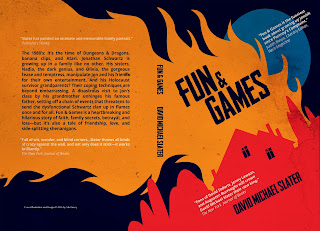
Author David Michael Slater is under the spotlight today. We’re chatting about his (adult) comic drama, Fun & Games.

Bio:
David Michael Slater is an acclaimed author of over 20 works of fiction for children, teens, and adults. His work for children includes the picture books Cheese Louise!, Flour Girl, and The Boy & the Book; the forthcoming early chapter book series, Mysterious Monsters; and the teen series, Forbidden Books, which is being developed for film by a former producer of The Lion King. David’s first work of non-fiction, We’re Doing It Wrong: 25 Ideas in Education That Just Don’t Work – And How to Fix them will be released this fall. David teaches in Reno, Nevada, where he lives with his wife and son.

Welcome, David. Please tell us a little bit about Fun & Games.
The 1980s: it’s the time of Dungeons & Dragons, banana clips, and Atari. Jonathan Schwartz is growing up in a family like no other. His sisters, Nadia, the dark genius, and Olivia, the gorgeous tease and temptress, manipulate Jon and his friends for their own entertainment. And his Holocaust survivor grandparents? Their coping techniques are beyond embarrassing. A disastrous visit to Jon’s class by his grandmother unhinges his famous father, setting off a chain of events that threatens to send the dysfunctional Schwartz clan up in flames once and for all. Fun & Games is a heartbreaking and hilarious story of faith, family secrets, betrayal, and loss—but it’s also a tale of friendship, love, and side-splitting shenanigans.

Some reviews:
“David Michael Slater’s 1980s coming-of-age story fuses intense family dysfunction with literary intelligence. Mr. Slater throws all kinds of crazy against the wall—and not only does it stick, it works brilliantly…Fans of David Sedaris, Jenny Lawson, and Augusten Burroughs will crown David Michael Slater their new king.” –THE NEW YORK JOURNAL OF BOOKS

A Holocaust-survivor grandmother who makes macabre jokes. A famous father whose anti-religious books attract sexually-desperate groupies. Sadistic sisters, an alcoholic mother, an unusually high body count for a novel this funny, and a plot that encompasses Hebrew school, porn producer thugs and a faltering orgy for literary deconstructionists without missing a beat. Even more remarkable, David Michael Slater’s Fun and Games is a male coming-of-age story that doesn’t rely on shock humor or gratuitous offense for chuckles–it’s hilarious because it’s tragedy happening to somebody else, a boy named Jonathan, who in terms of teen hormones and bewilderment could have been us…Fun and Games is the funniest book about growing up Jewish since Portnoy’s Complaint.” –Judith Basya, HEEB Literary Editor

What inspired you to write this book?
It’s “geographically autobiographical” in that the protagonist grew up in my house and travels a similar path to the University of Michigan, but otherwise his family does not resemble mine at all. That said, the book is about the kind of issues I grappled with growing up.


Excerpt from Fun & Games:
Sixty seconds later, the video had been returned to its drawer, and the class was sitting up straight, staring at both Myna’s blue velour running suit and the lavender scarf on her head, while Tziporah introduced her as a brave woman who had seen the kinds of things she prayed every night we would never know, but about which she had to make sure we knew, which is also why we’d been watching that awful movie.
“It is in March, 1939,” Myna said with no further ado. “I come here to America with my first husband, Nathan Schwartz, from Moravia, Czechoslovakia. We leave just weeks after Hitler’s armies come and call it part of their Protectorate. We have a tiny time to get away because the first ‘Protector’—he tries to pretend for a while that they weren’t there to murder us all good and dead.”
I started clapping. I didn’t mean to, but I thought it wasn’t absolutely impossible that she was done. There wasn’t all that much left to the story. Everyone turned and looked at me, so I stopped. But I could see from their eyes my clapping was the first interesting thing that had happened all class long.
Myna went on to tell how she and Nathan had owned and operated a small general store in Moravia for nearly ten years, then how they sold it in late 1938, even before their country lost its bordering territories (and thus all its defensive capabilities) because they could “read the letters on the wall.”
“Nathan was a pessimist, thanks to God,” Myna told my bored class. Then she added, “We are all of us pessimists now. Do you know why this is so?”
Receiving no response, she answered her own question. “The pessimists went to America,” my grandmother declared with a twisted grin and her finger in the air. “The optimists went to the gas chambers.”
I clapped again. Only four claps this time because Tziporah gave me the Major Screw Eye. Fortunately, no one appeared to be listening.
Myna looked a bit concerned about the lack of reaction she was getting, but nevertheless proceeded to share the boring story of her flight to America, the gist of which was that after selling their store, she and Nathan applied for visas with a group of extended family members. Neither had siblings or living parents. The Nazis had by then taken over, but somehow the applications were approved anyway. Myna ascribed this amazing good luck to the chaotic nature of those first uncertain weeks. “We could have been approved for tickets to the moon!” she cried. “Such numskulls, they were! No one knew who was in charge of what or what was in charge of who! All we needed was some money for a nice Jewish bribe, and poof! we are coming to America. Any questions?”
She was warming up. That last remark was a bad sign. Any minute now she was going to tell a Jewish joke. The world was about to find out that my grandmother, the Holocaust survivor, told Jewish jokes. But maybe she was done. There was no way anyone was going to ask a question.
Sarah Glickman raised her hand. I wanted to chop it off. Where was our broadsword when I needed it?
“Did you keep in touch with everyone after you got here?” she asked.
It was my impression that a dozen or so family members made the journey, though neither names nor exact numbers were ever made clear because the entire group wound up scattered across the country. We were never in contact with any of them, and Myna never talked about her relatives except to say they didn’t get along.
My grandmother shrugged. “To run for our lives—on this, we could agree, but nothing else. Once we got off the boat—What’s the point? Besides, most of us got different names when we arrived to Ellis Island.”
Sarah had no follow-up question, thank God. I prayed we were finally done, but someone else asked what Myna and Nathan did when they got to Pittsburgh.
Damn you all! I wanted to scream. You don’t care!
“Some money, we still had,” Myna explained. “We open a new general store in thirteen months, if you can believe! My son, Michael—he was born in 1944, but my Nathan died from cancer in the liver just a year later, so I run the business myself and raise him there. But then, many years later, I finally married to Jon’s grandfather, Leon.
I stood up and clapped like crazy. Show over.

What exciting story are you working on next?
My first YA, a book called You Must Go On.

When did you first consider yourself a writer?
Probably when I saw my name on the first published book, a picture book called Cheese Louise!

Do you write full-time? If so, what's your work day like? If not, what do you do other than write and how do you find time to write?
I’m a full-time middle school teacher (English). I write a little bit each day whenever I find the time. You’d be surprised how even 15-minutes here and there can add up!

What would you say is your interesting writing quirk?
I don’t plan out my books. I just write until I hit a wall, then start revising it from the start, which always gets me a little bit further. When I hit another wall, I repeat the process over and over until I get to an ending I didn’t know was there.

As a child, what did you want to be when you grew up?
A professional soccer player.

Anything additional you want to share with the readers?
I appreciate your interest in Fun & Games. It’s being considered by a number of movie producers right now, so I hope to have good news on that front soon!

Links:
Website | Twitter | Book | Facebook

Thanks for being here today, David.

Tuesday, February 7, 2017

Interview with contemporary women’s fiction author Katie O’Rourke

Author Katie O’Rourke joins me today to have a conversation about her contemporary women’s fiction novel, A Long Thaw.

Bio:
Katie O'Rourke was born and raised in New England, growing up along the seacoast of New Hampshire. She went to college in Massachusetts and graduated with a degree in gender and sexuality. She lives in Tucson, Arizona where she writes, loves and is happy. 

Monsoon Season, her debut novel, was a bestselling e-book. A Long Thaw was released in 2014, followed up by Still Life, a collection of short stories. Her most recent novel, Finding Charlie, was selected for publication by KindleScout.

Please tell us about your novel.
A Long Thaw is about two female cousins who were close as children and reconnect as adults. Abby and Juliet were born into one big, close, Catholic family. But the divorce of Juliet’s parents fragments this family and sends the girls in very different directions. 

Juliet grows up too quickly, on the west coast, forced to be responsible for her younger sisters as well as an alcoholic, single mother. On the east coast, Abby grows up a pampered, sheltered only child. As women, they try to mend the rift and come to terms with the way their shared history connects them in spite of the years apart.

What inspired you to write this book?
I've always imagined A Long Thaw as a modern interpretation of the old prince and the pauper story. Abby and Juliet are cousins who, until the age of ten, live the same privileged, sheltered lives in a big Irish Catholic family. When Juliet's parents divorce, her mother moves across the country so that she no longer has that safety net. The cousins reconnect in their twenties and the book deals with the ways we are changed by our experiences as well as the ways we are unchangeable.

Excerpt from A Long Thaw:

Abby
            In September, Ryan comes home from work and tosses the lease on the kitchen table. “It’s that time again,” he says as he removes his tie, hanging it over the back of a chair.
            Abby stands at the stove, pushing the chicken stir-fry with a spatula.
            After graduation, they both took jobs in Boston and neither could afford to live in the city without a roommate. Living together just made sense; it was about practicality. Love was incidental.
            Ryan kisses her on the cheek and gets a pen out of the drawer beside her. He signs his name and holds the pen out towards her.
            They have shared the apartment for a year. They do their own dishes, take turns making dinner, split all the bills, fifty/fifty. They never argue with raised voices. They renewed in March without much discussion. Their signatures side by side on a legally binding document caught Abby’s attention, distracting her from the landlord’s monologue on snow plows. She handed the papers to him with a reluctance she hadn’t quite understood.
            Abby sets the spatula on the counter and reaches out her hand. Then, she hesitates, drops her hand back to her side. They look at each other.
            “What?” Ryan says. His sandy hair curls at the edge of his ears, overdue for a haircut.
            “I’m not sure about this.” Abby's as surprised as he is to hear herself say this.
            “What do you mean?”
            The stir-fry is starting to smoke. Abby turns off the burner. Ryan waits, still holding out the pen.
            “What are we doing?” Abby asks.
            Ryan expresses his confusion with a shrug.
            “How many times do we renew this lease? Is this it? Is this all you want?”
            Ryan turns his back and places the pen on the table. “I don’t know what you want me to say.”
            Abby crosses her arms. “I don’t want you to say anything.” Especially not that, she thinks. As if she could tell him how to act and that would fix everything; the fact that it didn’t naturally occur to him was just irrelevant. “I’m not asking for anything. I never ask you for anything.”
            Ryan turns around. “Isn’t that exactly what you’re doing?”
            They look at each other without talking, locked in a silent battle of wills. Ryan blinks first. “Abby, we’re young,” he says, as if this has meaning.
            “I know we’re young. I just need to know if you want this to work.”
            He sighs then, a deep sigh that signals annoyance or defeat or exhaustion. Abby isn’t sure which. “Are we in this together?” Abby asks. “Are you in this?”
            “I love you.” Ryan steps closer, but Abby backs away.
            “Yeah, but what does that mean? You love me in this exact moment and possibly for the next six months?” Abby gestures to the paper on the table.
            “I can’t see into the future.”
            “You don’t have to. You just have to want it.” Abby studies Ryan’s face. “I just need to know it’s a possibility, that you see us as a possibility.”
            Ryan sighs again. Defeat, this time. “I don’t know what I see.”
            Abby leaves him standing in the kitchen. She isn’t hungry.


What exciting story are you working on next?
Blood & Water is about family, in its various manifestations: the one you're born into, the one you choose and the one you create. The novel follows five characters: a young mother named Ally, the deliberately childless Tim and Sara, single dad David with a college-bound daughter and David's little sister, Delilah, who shows up on his doorstep with a secret.

On the surface, these friends are on very different paths in their lives with seemingly little in common, but they connect in meaningful and sometimes unexpected ways. Their experiences overlap in a way that reminds us what it is to be human.

When did you first consider yourself a writer?
I started calling myself a writer in college, but it took me awhile before I felt comfortable enough to claim it when answering the question at parties: “So, what do you do?” I think it took the publication of my first book.

Do you write full-time? If so, what's your work day like? If not, what do you do other than write and how do you find time to write?
I have never been a writer who forces a daily output. Some days the inspiration hits and some days it doesn’t. There’s definitely value to carving out regular writing time and making it a priority. I try to participate in NaNoWriMo every year to help me remember that.

What would you say is your interesting writing quirk?
One of my favorite things to do in my work is have characters who pop up in subsequent books, even though I don’t write sequels. The imaginary world that I constructed for my first novel, Monsoon Season, is the same world that exists in A Long Thaw and Finding Charlie. Characters overlap because they're inhabiting the same space. A main character in A Long Thaw is a peripheral character in the book I’m writing now.

As a child, what did you want to be when you grew up?
As a young child, I thought I’d be a teacher. I think a lot of kids imagine that because it’s one of the only professions we see up close. By high school, I was thinking about being a psychologist because I’m endlessly fascinated by issues of identity and family dynamics, by the nature vs. nurture debate. These are things that inevitably find their way into my fiction.

Links:

Thanks for being here today, Katie!

Monday, February 6, 2017

Interview with writer Jeffrey Konis


Writer Jeffrey Konis joins me today to talk about his new historical fiction / memoir, The Conversations We Never Had.

Bio:
After practicing law for many years, Jeffrey H. Konis left the profession to embark on a career as a high school social studies teacher. His first book, From Courtroom to Classroom: Making a Case for Good Teaching, offers a unique perspective for teachers who seek to inspire their students to learn for the sake of learning.

His latest work, The Conversations We Never Had, is a historical fiction novel / memoir about his relationship with his grandma. It highlights the importance of family history.

Jeffrey loves reading, collecting fine art photography, soccer – especially Liverpool F.C. – travel, and his family most of all. He currently resides in Goshen, New York with his wife, Pamela, and sons, Alexander and Marc.

Welcome, Jeffrey. Please tell us about your current release.
My father, a Holocaust survivor, lost his parents by the time he was nine and remembers virtually nothing about them, including what his father looked like; no pictures of him exist. He was ultimately brought to this country by his mother's younger sister, also a survivor, to raise as her own. My dad never asked, for one reason or another, never asked about his real parents. I had moved in with his aunt, my grandma Ola, and lived with her for over two years. It was not until many years after her death, that I realized that I, too, never asked her the questions my father never asked. The Conversations We Never Had is a chronicle of my time with Grandma Ola and my imagining of the stories she might have shared had I only thought to ask the questions.

What inspired you to write this book?
The inspiration for writing the book, based upon profound regret, stems from the fact that it seemed to be the only way I could answer so many unasked questions, if only in my imagination. I also simply needed to write it for my grandmother, for my father and for myself.


Excerpt from The Conversations We Never Had:
From Chapter 2 – Grandma Ola and Me
Over the following days, I found myself picking up the old routine of going to classes, hitting the library, getting a slice or two for dinner, going home and hibernating in my room. Grandma would occasionally check on me, I think more than anything to make sure it was indeed me and not some wayward stranger. I felt bad not spending more time with Grandma the way I had that night when we talked about her dad, but I guess I was too tired after my long days or unsure how to restart the conversation. I knew Grandma was lonely, lonelier with me around than she would have been alone. Then there was something of a break in my schedule. It was the weekend after Thanksgiving and, caught up with all my work, I decided to spend some time with Grandma and talk. Late Saturday afternoon, after the caregiver had left, I approached her.
"I know it's been awhile but I was wondering whether we could talk some more, if you're up for it, that is."
"Up for it? I've been 'up for it' for the last two weeks. What do you think, that I'll remember these things forever? You think my memory will get better as I get older?"
"I know, I'm sorry. I've been busy with school and . . . ."

"Jeffrey, you barely say hello to me. How many grandmothers do you have anyways? Well?"
Interesting question but, of course, she was right. My maternal grandmother died when my mother was a young girl; I never knew her father, Grandpa Eugene, who died when I was two.
But Grandma Ola said something else that made me stop to think for a second: her memory would surely deteriorate, and in the not-too-distant future. Once that went, so did any chance of learning about my paternal grandparents. There was now a sense of urgency to my mission. Indeed, there were increasing signs that her mind was starting to slip.
The phone had rung, a few nights previously, and I gave Grandma first dibs to pick up the phone to see who it was, as this was pre-caller ID. The phone kept ringing and I looked in on Grandma, who I knew was lying on the couch in her room. The scene upon which I stumbled was humorous, though it should not have been: there was Grandma, holding a pillow to her ear and talking into it, "Hol-low? Hol-low?" I quickly picked up the phone just as my dad was about to hang up. He often called to check on both of us, to make sure that we hadn't yet killed each other, that we were still alive.

What exciting story are you working on next?
I haven't yet given serious consideration to my next work, assuming I have another one in me. My best friend of twenty years, who was more like a brother to me, died when we were in our thirties, leaving a young widow and three-year-old son. I sometimes think about writing of our friendship, our lives and his death. But then I immediately reconsider doing so; writing The Conversations We Never Had was quite painful. I don't know if the effort writing such a story would warrant the inevitable pain. Perhaps if I thought I could use some therapy in connection with his loss, some sixteen years ago (May 9, 2000), I might be more apt to write the book.

When did you first consider yourself a writer?
I considered myself a writer when my father had insisted that, rather than buy birthday cards containing someone else's words, I should make up my own cards with my words. I realized that I was actually pretty good at it. My favorite was a card I had written my dad for Father's Day: I wish you had me younger so I could have you longer.

Do you write full-time? If so, what's your work day like? If not, what do you do other than write and how do you find time to write?
I do not write full-time as I happen to be a high school social studies teacher who practices law on the side when I can. Having a teacher's schedule, i.e., summer's off, has allowed me the time to write. The challenge remains, however, that I must isolate myself from everyone when I write.

What would you say is your interesting writing quirk?
I don't know if I have a writing "quirk" per se but I do write long-hand, typically, in my living room when my wife is out shopping and my two boys are otherwise occupied When writing fiction, I will plop in my favorite chair, waiting to be inspired, for some story to, more or less, drop in my lap. If no such inspiration is forthcoming, which is more likely the case, I will get up to leave and do something else. I will return at some other point and repeat the "process;" I just never know when something will just hit me out of nowhere.

As a child, what did you want to be when you grew up?
When I was little, I dreamt of playing tennis professionally, not that I ever had a chance of ever doing so. It was just the idea of playing tennis for a living, travelling the world and, ultimately, being your own boss at the end of the day sounded simply perfect.

Anything additional you want to share with the readers?
Soccer is my religion; Liverpool Football Club is my faith - no - my belief. Bill Shankly, the godfather of Liverpool FC, once noted how people thought that football, to him, was a matter of life and death. Shankly responded that it was more important than that. Not literally, of course, but I definitely got the point. One more of his favorite quotes that had always very much appealed to me as a fan was, in reference to Liverpool: "If you don't support us when we're losing then don't support us when we're winning." What must be painfully clear by now is that I could on about LFC and soccer but I will, mercifully, spare readers.

Links:

Thanks for being here today, Jeffrey.

Friday, February 3, 2017

Interview with non-fiction writer Wendy Brown

Writer Wendy Brown is my guest today. She’s written an educational self-help book on relationships called, The Six Passions of the Red-hot Lover: Find out which one is yours.

Bio:
Wendy Brown is an individual and couples’ therapist who estimates she has done over 35,000 hours of therapy and discussed love in most of them. She is in private practice in Toronto, Ontario, Canada. Her first book, Why Love Succeeds or Fails won the National Indie Excellence Award for a relationship book in 2014.

Welcome, Wendy. Please tell us about your current release.
The Six Passions of the Red-hot Lover asks if you know what type of lover you are. If you are a Red-hot Lover, you probably figure you could star in a great love story. You may very well be capable of mind-blowing sex; you might even do wild and crazy things in the name of love.

Passion is described as either a powerful, barely controllable feeling that can overtake you at times, or a delicate, intuitive sense much like an artisan has for his/her craft. It can produce drama with emotions ranging between despair and rapture. Passion can also cause you to do things that are wild and crazy in the name of love.

There are six passions; these are the drivers of passion for Red-hot Lovers:
Heartbreak: You don’t understand how or why someone totally loves you and then loses that love. The script that goes with this passion is the Lovesick Lover, a person who is so worried about rejection that he/she almost invites it.
Challenge: You need to find someone who ticks all your boxes and has the tenacity to pursue you. The Prince/Princess is the role for playing hard to get.
Pursuit: It’s important for you to tap into your deepest feelings to determine if you should go after a particular lover, whether or not this makes sense to anyone else. This passion produces the script called the Lover’s Fool; you could make a fool out of yourself or others.
Gallantry: You strive to do everything in your power to rescue your lover from a life without your love and protection. The accompanying role here is the White Knight.
Vindication: Having felt a perfect love and then something went wrong, you desperately want it restored. This passion produces the script called the Black Knight, which is all about rejecting disenfranchisement.
Attention: You thrive on the spotlight, having your innermost wants and needs understood and met. The role that goes with this passion is the Drama King/Queen whose worst fear is being invisible.
You can figure out which passion is yours by taking the tests for each one.

As you can see, there are a lot of overtones in the passions and the scripts from the medieval courtly love period. In the book, the author interviews Ron, a high school teacher and self-proclaimed Red-hot Lover. He tells many stories about the courtly lovers to illustrate his points. There are also current day examples of Red-hot Lovers, like Elizabeth Taylor and Richard Burton, Princess Diana and Jackie Kennedy Onassis.

Red-hot Lovers are often criticized as high maintenance. Passion can be finicky and difficult; it may even fizzle out.

But, there are people who adore Red-hot Lovers. After all, Red-hot Lovers are the people who are capable of going to any lengths for love. When they’re on, you can feel their passion in the air, see it in them and forever in the world it feels like a force the lovers and everyone else must reckon with. They just might be the quintessential great lovers of all time.


What inspired you to write this book?
My first book, Why Love Succeeds or Fails includes descriptions of four types of lovers: Gripping Dramatist, Passionate Adventurer, Sensible Compromiser and Joyful Diversionist. I decided to go into some depth about each type individually. I started with the Gripping Dramatist and re-named it the Red-hot Lover.

As an individual and couples’ therapist, I fundamentally believe that we need a clear and easy way to understand love and lovers. So, when you meet someone online or in person, after a few minutes you can say to yourself ‘Aha, a Red-hot Lover, just like me.’ That just might save you a lot of stumbling around, getting things wrong and wearing out the relationship.

Excerpt from The Six Passions of the Red-hot Lover:
This is the generic Red-hot Lover Script. There are additional more detailed scripts for those who have one of the passions.

When I fall in love, I have the lofty, regal feeling of being in the right. I have to admit that I spend a lot of time in my life doing what feels right and true to me. I tap into my inner sense of what is and isn’t warranted by the love I feel. When it comes to love, I have the passion of a craftsman/woman and a gifted lover. My beloved generally feels very connected to me as I thoroughly revel in the angst, drama and chaos that fill my life and make me feel fully alive and thriving. I need my lover on board, ready to explore all of that with me, at the edge of his/her seat in the excitement of it all.

I have to say, to a great extent, passion is my guide and my governor. It allows me to run the full gamut from being a vulnerable candle in the wind to a super-charged rapturous lover.

My passion does make it difficult for me to get and maintain a perspective on a given situation. Typically, I’m too busy attending to my emotions which constitute my driving force. I do realize that this means I can’t see clearly or fully; I miss a lot because of that. But I love being guided by my passion so much that I really can’t see myself changing.

My perfect state is being passionately in love. It makes me feel like royalty that has arrived. I am so pleased and proud that I feel like I could burst into a million glorious pieces.


What exciting story are you working on next?
My next project is writing about my second type of lover: the Passionate Adventurer. I suspect I may rename that one as well once I start working on it.

When did you first consider yourself a writer?
All through school, I was told I should be a writer. When I finished my undergrad degree in English and went on to grad school, I stopped writing and didn’t start again for decades. When I look back, I think I’ve always considered myself to be a writer.

Do you write full-time? If so, what's your work day like? If not, what do you do other than write and how do you find time to write?
No, I don’t write full-time; I am an individual and couples therapist in private practice. My work day involves seeing people who have quality of life or clinical issues and want to grow and change. I regularly deal with grief, heartbreak, conflict, love and joy. That’s my full-time job. I write whenever I have a chance. If one of my clients cancels an appointment, I write. If I feel inspired wherever I am, I jot down notes. If I have a writing deadline and no time to write during the day, I write during the night.

What would you say is your interesting writing quirk?
Have you heard of people who decorate a room by starting with one item that catches their fancy? I once saw someone inspired by a green apple. That’s how I research. I become intrigued by something and then everything flows from there. With ‘The Six Passions of the Red-hot Lover’, I started with my initial concept of the Gripping Dramatist, which intuitively led me to look up the beginnings of Valentine’s Day and peoples’ associations with the color red. From there, I looked into the Courts of Love in medieval Europe.

As I research, I write. So, I’ll do a paragraph on something, a chapter on something else. Then I start to pull it together and see what kind of shape it naturally takes. Of course, I have to critique it for content, form, etc. which I generally do three times. Pretty much, I do three complete re-writes.

As a child, what did you want to be when you grew up?
Writing was my first love. At about the age of twelve I remember reading about mental illness and deciding that I had to figure out how peoples’ minds work. I used to really enjoy character analysis in English literature because it brought the two together.

Anything additional you want to share with the readers?
Yes, I was writing The Six Passions of the Red-hot Lover during the campaign for the Presidency in the USA. I was very busy and didn’t read much about it. Then, when Donald Trump was declared the winner, I read everything I could. I was trying to understand how and why he won. It was then that I realized he is a Red-hot Lover.

And President Trump is extraordinary. Your average Red-hot Lover has one passion; he appears to have three. By my estimation, his passions include pursuit, vindication, and attention.

Links:

Thanks for being here today, Wendy!