Showing posts with label virtual book tour cafe. Show all posts

Thursday, April 3, 2014

Interview with historical fiction author Lissa Cowan

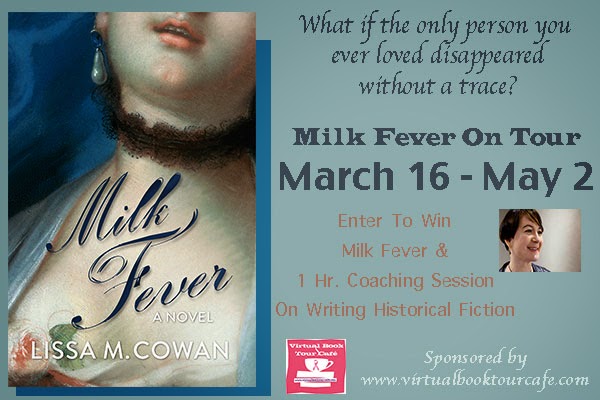
Historical fiction author Lissa M. Cowan is here today sharing about her new novel Milk Fever.

Bio:
Lissa M. Cowan is the author of Milk Fever and founder of Writing the Body. She speaks and writes about storytelling, creativity, work-life balance and creative spirituality. She is a Huffington Post blogger and writes regularly for Canadian and U.S. magazines and newspapers.

She is co-translator of Words that Walk in the Night by Pierre Morency, one of Québec’s most honoured poets. She has been writing and telling stories in one form or another since she was six years old and has received awards for her writing from the University of Victoria’s Writing Department and from The Banff Centre. She is an alumna of The Banff Centre and The Victoria School of Writing. She has had some wonderfully talented teachers along the way such as Nino Ricci, Jane Rule and Daphne Marlatt who have helped her hone her writing craft.

Lissa believes that inspiration for writing can come from anywhere and that lifelong creativity begins by cultivating a deep awareness of ourselves, and the world around us. She coaches her students to develop the skills to tune in and trust their intuition. She believes that true creative work begins with a loving relationship to self and spreads outwards to encompass all living beings.

When she’s not writing or teaching, you can most likely find her in a cafe working on one of her stories or book ideas. She just started work on a creative non-fiction book, though it’s too early right now to spill the beans on that one!
She holds a Master of Arts degree in English Studies from l’Université de Montréal and lives in Toronto, Canada.

Welcome, Lissa. Please tell us about your current release.
Milk Fever takes place at the time of the French Revolution. In 1789, Armande, a wet nurse who is known for the mystical qualities of her breast milk, goes missing from her mountain village.

Céleste, a cunning servant girl who Armande once saved from shame and starvation, sets out to find her. A snuffbox found in the snow, the unexpected arrival of a gentleman and the discovery of the wet nurse’s diary, deepen the mystery. Using Armande’s diary as a map to her secret past, Céleste fights to save her from those plotting to steal the wisdom of her milk.

Milk Fever is a rich and inspired tale set on the eve of the French Revolution–a delicious peek into this age’s history. The story explores the fight for women’s rights and the rise in clandestine literature laying bare sexuality, the nature of love and the magic of books to transform lives.

What inspired you to write this book?
I first came across the term wet-nursing in Laurence Sterne’s Tristram Shandy while researching for my Master’s thesis. I looked up the word, and shortly after began to see it in many other books I was reading from the eighteenth century—mostly ones written by French novelists. I picked up a copy of George Sussman’s Selling Mother’s Milk: The Wet-Nursing Business in France and was astonished to discover that wet nursing was an industry in France similar to textiles or porcelain.

What particularly intrigued me was a widespread belief at the time that the thoughts of the mother who breastfed could become impressed upon the child. I thought, what if a wet nurse existed who was educated (most of them were not)? What would her milk be like and how—in the fantastical world of the novel—might this influence the babies she nursed?

Excerpt:
Armande handed me a book that felt clumsy and stiff in my hands. I pressed it with all the strength I could bring to bear. She said the pages of books were made from cotton and linen rags stamped into pulp, then pressed into paper and hung to dry. I laughed at her for telling such a lie because I thought maybe she was just like my father who told tall tales to make me behave. Rows and rows of lines she called words looked odd to me. Many times I searched hard within every letter, every sound to find meaning. The letters cut my tongue as thorns on a rose bush, each one sticking to me. I could not speak the next letter until the one before it came unstuck. Soon after the word was finally spoken, my lazy tongue quit my mouth.

Months later, the wet nurse asked me to read a passage aloud. The first line was, Bodies gliding on morning’s cloak of dew, lit up as iridescent insect wings they flew. When I came to the word iridescent, Armande said to say it slowly, one letter at a time. She told me it was from the word iris for the flower, and escent for colours of the rainbow that change as a dragonfly in the sun. Finally, when my tongue began working with me and worrying less, she asked me to say other words like deliquescent, effervescence, and florescence. These newfound words were as rare gems dug up by the wet nurse solely for me. She wrote them out with big stokes that filled a whole page. I rubbed my eyes to make the words go away, yet they only stayed there waiting for me to say them.


In the days and months that followed, I learned to read and write well, and I learned first-hand about the miraculous effects of Armande’s milk on babies. Before, I was a mere servant watching from afar as the wet nurse suckled. Then I was part of her life, holding and changing babies, burping them, and rocking them to sleep. Armande cared for three babies during this period yet not all at once. She would also tend to others from time to time, reassuring worried mothers in soothing tones as gentle and sweet as the milk itself. First there was Jacques who she still cared for. His mother died in childbirth and Armande stepped up to nurse him without a thought about payment. Caroline came after, then Héloïse. The first time I watched from up close as Jacques drank her milk was in the drawing room.

Armande was on her favourite oak chair with the sagging blue leather seat and worn arms while I sat on the sofa. Suddenly Jacques stopped sucking, then gazed at me knowingly, his eyes full of light. In that instant, a slim ray of sun gleamed through a crack, lighting up the darkness inside me. My hands shook. Sweat ran down my cheeks and the back of my neck. Just as she said her father sometimes described it, we were entering a new age driven by light. And I, a peasant girl whose father and mother never held a book, would be there to witness the change.


What exciting story are you working on next?
I’m playing around with a few ideas, both of them potential novels or novellas. The one I’m particularly keen to write takes place in Victorian England; another century and country to explore!

When did you first consider yourself a writer?
I knew I was a writer when I was about seven years old. I won a short story contest for a story about animals such as tigers, lions and a monkey, and never looked back.

Do you write full-time? If so, what's your workday like? If not, what do you do other than write and how do you find time to write?
I write full-time and write fiction part time. So in other words I work as a copywriter for my day job, which I love, and write fiction the other part of the time. I begin my workday writing for myself in the morning until about 1 pm. Then I do my client work for the rest of the day. I don’t answer email in the morning and try not to answer the phone during this time otherwise it’s hard to get back into what I’m writing.

What would you say is your interesting writing quirk?
I water the plants in between writing spurts and I usually talk to the plants as I go. Obviously I don’t water them everyday, but when I do, it’s usually when I need a writing break to let something percolate. My plants know all my deepest thoughts and worries.

As a child, what did you want to be when you grew up?
A writer.

Anything additional you want to share with the readers?
Just that writing isn’t easy. I love what I do, but it’s hard work and takes dedication and commitment to stick with it. Sometimes people think that if you’re good at writing, then it must come easily. I did about 30 revisions of my novel and so I might even say that it becomes harder to write because each time you produce something, you set the bar higher.

a Rafflecopter giveaway

Tuesday, March 25, 2014

Interview with the sci-fi author team known as Casey Lea

Today I have the writing team known as Casey Lea here to talk about their first two books IceFlight and its sequel Frostbite, and also give us a glimpse into future books.

Casey Lea is offering five gift pack giveaways during the virtual book tour. Each includes: (1) signed IceFlight paperback, (1) signed Frostbite paperback, and (1) $20 Amazon gift card. To be entered for a chance to win, use the form below.

Bio:
Casey Lea is a mother and daughter writing team with a strong interest in science fantasy. The Casey Lea partnership began in 1990, with the arrival of Emma Casey Frost, first daughter of Shelley Lea and Gary. Although Emma was a very precocious child, it took another fifteen years before she began working with her mother.

Shelley Lea (pronounced ‘lee’) was born on a snowy June day, near the bottom of the world, in Invercargill, New Zealand. Reluctant to supply a date of birth, she would rather claim several decades of maturity, but only a few days of actual wisdom. Those decades have covered a range of jobs, a couple of degrees (including English Lit), one great husband, plenty of travel, two gorgeous daughters, several scatty cats and one charmingly dumb dog. They’ve also included an on-going struggle to put pen to paper in any spare second. This has led to some dire poetry, some eyebrow raising children’s stories and finally to something resembling a novel. This languished in a sadly disjointed and hand written form until…

Emma Casey inherited her mother’s love of books and the ability to string two sentences together (sometimes three). She proved to be the missing link in trying to actually finish a manuscript. Younger, savvier and able to turn on a computer without causing it to explode, she picked up the book and ran with it. Emma is also studying graphic design and happily provides Casey Lea’s cover artwork.

Welcome, ladies. Please tell us about your current release.
We’re delighted to be releasing Frostbite, the second book in our Iron Altar trilogy. Our favourite lost-in-space-and-kicking-alien-butt slave Darsey is back, but now she’s a mother and learning to be brave in an entirely different way.

What inspired you to write this book?
All the stories we’ve loved that have brought joy to our lives.

An excerpt from Frostbite…
Zak broke off when his words were lost in a thud and a grunt. Misty ducked her head further from cover to see what was happening. Ace. He'd finally managed to slither from his party burrow and do some work. Impressive work too. He must have taken Zak down with a diving tackle, but the nearest cover was meters away. Not a bad leap.
Unfortunately, Zak arched hard enough to throw Ace off and they came to their feet together. Two swords appeared and they attacked each other instantly. Their blades clashed repeatedly, without pause or hesitation.
Misty stopped and stared. She had never seen such a fight. Every blow was countered and each riposte was blocked. It was like watching someone fence with a mirror. There were no advances and no retreats. The fighters stood toe-to-toe, perfectly matched. The pace increased, until their swords were a blur, but still no one broke through with a blade.
Zak decompressed a second sword and slashed at Ace recklessly, driving him toward the cliff. The clash of blades was constant as the Beserk pushed forward. Misty took half a step toward them, but Ace spun around Zak, away from the drop. He swung his sword over his shoulders to guard his back and caught the blades trying to cut him down from behind. He twisted his arms while crouching, to turn and sweep one of the weapons from Zak’s hand.
Ace leapt high, while Zak jumped too. Their swords collided and they both swung a fist as well. Ace smashed his opponent in the mouth, but a punch like an anvil glanced from his chin and he staggered. He fell to a knee, before surging upright to back away and look for the Beserk. He attacked as soon as he saw the stranger - still on his back in the dirt.
Zak sprang to his feet just in time to counter the blow, then took an unsteady step and Ace paused too, breathing heavily despite com support. The stranger used the back of his hand to wipe blood from his lips and frowned when he saw Ace wiping his own bloody mouth.
“Get out of my head, snot balls.”
“Glad to,” Ace sneered. “I don't usually play in garbage.”
Zak sprang forward, but this time he put his full weight behind his swing. The wild blow was a risk, but Ace was too surprised to take advantage of it. He belatedly tried to block Zak’s sword, but its momentum was too great. Both swords flew through the air and Misty jumped aside when they clattered past. Ace reached to his wrist for another blade, but was too slow. This time Zak tackled him and they went down together. They grappled with each other and rolled across the plateau toward the cliff.


What exciting story are you working on next?
Sacrifice, which is the last book in our trilogy. The Devourer returns to feed and either Darsey or Amber will lie on the iron altar. Someone has to die, but who?

When did you first consider yourself a writer?
Still working on that, particularly since we self-published. However, every book sold and every new review makes it more real.

Do you write full-time? If so, what's your work day like? If not, what do you do other than write and how do you find time to write?
We work as often as we can and don’t have formal jobs to distract us. Fortunately, because we don’t know how we’d manage.

Shelley has a seven-year old, who seems to have boundless energy. She’s a lovely little girl and hubby Gary is a great dad, so it’s not too bad. His help and that wonderful innovation called school make a writing life possible. It’s early Sunday morning and Shelley’s still in her dressing gown, sitting beside daughter number two, who has a nasty virus. However, her temperature has dropped (still above normal) and she slept last night, so seems to be on the mend. She’s presently hatching furblings, so this is a good time to write. Grab every moment…

Emma helps her husband Mike with graphics for his website design business and spends most of her time in front of her two computer screens in the dining room. However, all that is about to change. Emma and Mike are expecting their first child on April 26, which is Emma’s birthday. So life is about to become much more distracting. How that will affect Sacrifice remains to be seen…

What would you say is your interesting writing quirk?
Jumping up in the middle of the night when inspiration strikes. We also have some quirks as a writing team. We often play tag with phone calls and emails. We exchange bits of text and take turns with it, conferring by phone as required.

As a child, what did you want to be when you grew up?
When Shelley was young she always wanted to be an astronaut. Which was insane. Math was a foreign world, she was careful to the point of timidity, not particularly athletic and not American. It was never a runner, yet still it appealed.

Emma has had two childhood dreams, the first of which she’s been pursuing for the past few years in the form of graphic design. She is about to fulfil her second dream of becoming a mother!

Anything additional you want to share with the readers?
Our bank account number. Please feel free to deposit.

Ways to connect with us and learn more about our books:


Thanks Casey Lea!

a Rafflecopter giveaway


Thursday, March 13, 2014

Interview with writer, actor, & mystery novelist David Flynn

Today's guest wears many hats, but we'll get to know him as mystery novelist, David Flynn, as he tells us a bit about his debut novel, The Whisper Man.

During his tour, David will be giving away a DVD of THE UNDYING, a movie he wrote and produced, to a lucky commenter. To be entered for a chance to win use the form below.

Bio:
David Flynn has worked as a writer and actor (under the screen name Patrick Flynne) and is a member of the Screen Actors Guild and the American Federation of Television and Radio Artists (SAG/AFTRA).

He’s appeared in numerous motion pictures, both studio and independent productions, and in the daytime series, All My Children, Another World, Guiding Light, and Loving and as the ongoing character Representative Ingersoll in videos for The Onion.

He has also performed as a spokesperson in numerous industrial films and television commercials, as a voiceover artist in radio broadcast commercials and as an English language narrator, editor and writer for several series on Ebru-TV, a Turkish company currently broadcasting on the Internet.

David has written 18 screenplays, including THE WAR CHANNEL, a Bronze Award Winner for Best Dramatic Screenplay at the Worldfest/Houston International Film Festival. This script was optioned by the Auerbach Company at Columbia TriStar Television. He has also co-authored two screenplays, one a Silver Award Winner for Best Dramatic Screenplay at Worldfest.

His recently produced screenplay, the supernatural thriller THE UNDYING (www.theundyingfilm.com) starring Robin Weigert, Wes Studi and Jay. O. Sanders is now in distribution domestically by MTI and internationally by Inferno Films. Under its original title, THE BRIDE OF DREAMS, the screenplay was one of fifteen semifinalists (out of a total of 3900 entrants) for a Nicholl Fellowship, a screenwriting competition sponsored by the American Academy of Motion Picture Arts and Sciences (AMPAS). The Nicholl is considered to be the most prestigious screenwriting competition in the industry.

His novel The Whisper Man is the first in a series of mysteries that focus on unusual crimes and criminals in New York City.

Welcome, David. Please tell us about your current release.
Sex, vanity, and psychology are the weapons a sociopath named David Barry uses as he kills for money in The Whisper Man.

David's prey - and profit - are the wealthy of New York City, with each murder crafted to look like a suicide, an accident or the work of another, but always with the goal of increasing David's balance sheet. When a close friend of Manhattan ADA Joseph Kane dies at the apparent hand of his wife, Kane refuses to believe in her guilt. He investigates the recent deaths of several prominent and wealthy New Yorkers and decides there may be an undiscovered killer behind them.

Kane develops a prime suspect and triggers a battle of wits with the brilliant and arrogant David Barry who must kill again, not for profit this time but to protect his identity. The jealousy of Kane's insecure wife and conflicts with his boss become the tools David will use to destroy his adversary.

What inspired you to write this book?
I worked in luxury real estate development in Manhattan for a number of years and came across a wide cross section of well-to-do New Yorkers both in business and in social settings. The wealthy can hire bodyguards and forensic accountants but it occurred to me that the more wealth one might have the more vulnerable one’s life and fortune might be to a totally unimagined threat.


Excerpt:
Later, witnesses at the scene would describe the young Latino with the greasy hair under the tightly tied “do-rag” who ran from the scene of the accident. They would describe the puffy jacket and hoodie he was wearing, the baggy jeans and the large Nikes with the shoelaces loosely tied in the street fashion of the day.They would point north on Eleventh Avenue and east on 29th Street where they saw him run. It all happened so quickly and so unexpectedly. That was all the Police would have to go on.
                                                                        #
            The driver of the Cadillac stopped running as he turned onto 30th Street after crossing Ninth Avenue. He slowed his pace to a street swagger until he reached the narrow opening between two buildings. He glanced around quickly before slipping into the alley. Sure that he was not being observed, he stripped off the jacket and the hoodie and threw them on top of a garbage can. Next he slipped off the oversize sneakers and the baggy jeans, and they followed the jacket onto the garbage can. He was confident that within a couple of hours they would be found by a bum or an addict and sold to someone else for the price of a few hours of diminished consciousness. Recycled into the city’s economy, they would never be identified as the clothes of a hit and run driver.
Underneath the Nikes he wore slender white tennis shoes. Finally, he slipped the do-rag from his head and used it to wipe the grease from his face and ditched it in a different trash can. David Barry, wearing a buttoned down shirt, crew neck sweater, khakis and an attitude of innocence, walked out of the alley and over toward Eighth Avenue.
            David decided that his plan had gone so well that he would take a leisurely stroll back to the scene of the accident and look over his handiwork before going out for dinner. By the time he reached 26th Street, a considerable crowd had gathered and was being held back on the south side of 27th Street. He joined the crowd and slowly worked his way to the front of the group. He watched the actions of the Police and the EMT team for about ten minutes before finally deciding on Thai food.


What exciting story are you working on next?
I’m now working on The Mischief Man, the second story in a series about unusual New Yorkers involved in crime.

When did you first consider yourself a writer?
This might sound corny, but it was right after I kissed the Blarney Stone. Up ‘til then the only writing I had done was business related. When I returned from Ireland my young daughter brought home a story about the Jersey Devil, a folk myth set in the Pine Barrens of South Jersey. I thought it would make an interesting movie so I wrote a screenplay that was rejected by agents and producers alike. Reading it over I realized it was bad and I needed to educate myself in the art of writing for the screen. The next story I wrote was the supernatural romantic thriller, The Undying. It did so well in the Nicholl Fellowship that I started writing and writing and writing. Most stories felt right for the screen, but THE WHISPER MAN just felt like a story that needed to be told in print.

Do you write full-time? If so, what's your work day like? If not, what do you do other than write and how do you find time to write?
I write when I’m not working as an actor or voiceover artist. A typical writing day usually begins by reviewing what I’d written the day before, using that as a springboard for the day’s efforts.

What would you say is your interesting writing quirk?
I most enjoy making sure that every character has his or her own voice. I draw on my stage experience to think about each character’s actions and motivations and try to make sure that comes out in their words and actions on the page.

As a child, what did you want to be when you grew up?
A diplomat. It took me a few years to realize I would be terrible at it and I’m glad I came to my senses before college.

Anything additional you want to share with the readers?

Play golf and ride a motorcycle – two of God’s greatest gifts to the human spirit.

Thank you, David!

Readers, don't forget to use the form to enter for a chance to win the DVD!