Showing posts with label book publicity services. Show all posts

Monday, June 22, 2020

New interview with crime fiction novelist Ed Duncan

A hearty welcome back to crime fiction author Ed Duncan. We’re chatting about his new novel, Rico Stays.

You can read our last interview about The Last Straw.

Bio:
Ed is a graduate of Oberlin College and Northwestern University Law School. He was a partner at a national law firm in Cleveland, Ohio for many years. He is the original author of a highly regarded legal treatise entitled Ohio Insurance Coverage, for which he provided annual editions from 2008 through 2012. Rico Stays is the third novel in the Pigeon-Blood Red Trilogy which began with Pigeon-Blood Red and was followed by The Last Straw. Ed, originally from Gary, Indiana, lives outside Cleveland.

Welcome back to Reviews and Interviews, Ed. Please tell us about your newest release.
Rico Stays continues the saga of the uneasy friendship between two men from different sides of the tracks, each of whom harbors a secret admiration for the other. Paul Elliott is an African American lawyer in a large, mostly white corporate law firm in Chicago, and Richard "Rico" Sanders is a white enforcer/killer for hire, but one with a conscience. Their paths cross when Rico is gravely wounded in a shootout with the hot-headed nephew of a local mob boss and three other men. Rico dispatches the three men, one of whom has a brother who has just been released from prison in California, but the nephew escapes and vows revenge. The brother arrives in Chicago also seeking revenge and joins forces with the nephew and others, but the brother is conflicted because of a budding relationship with an old girlfriend who thinks he has abandoned his criminal past.

After a brief hospital stay, Rico is released but he is in no condition to face multiple gunmen. Therefore, his girlfriend Jean persuades Paul to let them use Paul's cabin, located miles from the city, as a hideout until Rico regains his strength. Paul's girlfriend Evelyn has always been wary of Rico, and Paul allowing Rico to use his cabin causes a rift between her and Paul. After a few days, using Jean as bait, several killers lure Rico back to the city, and Paul and Evelyn are along for the ride and the climactic gun battle that follows.

What inspired you to write this book?
I knew practically from the start that I wanted to write at least a trilogy. With Pigeon-Blood Red and The Last Straw behind me, all that remained was to come up with a plot and a title for the third book. I knew I wanted Rico to be more vulnerable than in the first two books. Once I imagined him being wounded and needing Paul's help, the other elements of the plot fell into place. The title came to me while watching an old Barbara Stanwyck movie called Babyface. There was a scene where Stanwyck's lover asks her to get rid of her long-time maid, whose name was Chico. In response she replies gruffly, "Chico Stays." That gave me the idea for the title.


Excerpt from Rico Stays:
Cosgrove, however, hadn’t finished venting and didn’t appreciate Koblentz’s gesture. “You want some of this, old man?”

“I was just –”

Cosgrove interrupted him with a vicious slap to the mouth that drew blood. Koblentz fell to one knee, head bowed, and was silent.

“You bastard!” Jean yelled. She glanced at Rico, who was still in his car in front of her some ten yards away. She wasn’t sure how much he’d seen because his expression, as usual, was utterly inscrutable behind his aviators. She sprinted to Koblentz’s side and knelt beside him. “Are you okay?”

Cosgrove glared at her, then a cruel smile lifted his mouth. She was a mouth-wateringly gorgeous woman and his mouth watered. Taunting her, he pressed one foot against Koblentz’s back and slowly forced him to the ground. Jean’s eyes flashed and she straightened up and slapped him hard enough to make his head turn. At once surprised and enraged, he immediately drew his arm back to retaliate. Jean closed her eyes and flinched in anticipation. Cosgrove reached far behind him to increase the momentum of his blow and then he launched his open hand toward her as hard as he could, creating a swoosh of air as his hand traveled forward to meet Jean’s face.

But it never reached its target.

Rico had appeared seemingly out of nowhere and, with one hand, had grabbed Cosgrove’s wrist from behind, stopping his hand mere inches from Jean’s face. Now he stood behind Cosgrove holding his wrist in a vice-like grip from which there was no hope of escape. Slender and soft, Cosgrove was around five feet ten inches tall and weighed about one hundred and seventy-five pounds. Rico stood six feet two, weighed over two hundred pounds, and was solid muscle.

He was a killer, but not your run-of-the mill killer. He was exceptional at what he did, but he was not only that. He was also a killer with a conscience. He didn’t kill kids, he killed women only as a last resort, and he only killed people who “had it coming.” Or at least that was what he told himself, because sometimes it was a close call. But at least he tried. And that made him unique, as nobody else in his business gave a hit a second thought.

Cosgrove tried to turn to face him, but with just one hand holding his wrist, Rico prevented him from even budging. After Cosgrove stopped squirming, Rico twisted the man’s arm behind his back and wrenched it upward until he yelped in pain. Then he thrust his free forearm under Cosgrove’s chin and applied just enough pressure so that Cosgrove, with some effort, could still breathe and talk. Just.

Cosgrove squealed, “What the –”

“Shut up,” Rico said and turned to Jean who was helping Koblentz to his feet. “You all right?”

“Fine.” Her worried eyes met Koblentz’s. She smiled. “Are you okay?”

Gingerly wiping the blood from his face, he nodded and smiled back.

“Wait in the car,” Rico said.

“What are you gonna do with him?” Jean asked, a little apprehensively.

“Wait in the car.”

Jean started to press him but by now she knew the drill. She collected her shopping cart and she and Koblentz headed for the car. The boy, still on his back resting on his elbows, scrambled to his feet and stood staring at Rico in awe. Rico said, “Kid, get outta here.” Dejected, the boy slowly started to walk away. Raising his voice an octave, Rico said to the other gawkers, “That goes for everybody else, too.”

The edge in his voice did the trick. No one objected and no one lingered. Except the boy. He turned around after he’d taken a few steps and, in a voice just above a whisper, said, “Thanks, mister.”

The slightest hint of a smile appeared on Rico’s face. “Nice catch, kid.” That brought a grin to the boy’s face. He pounded the ball in his glove and hurried away.

Rico scanned the area in a 360-degree arc and, seeing no one besides the steadily retreating onlookers, released the choke hold on Cosgrove’s neck but maintained his grip on his wrist. Then he placed his free hand on the back of Cosgrove’s neck and, mimicking what Cosgrove had done to Koblentz moments earlier, he slowly guided him to the ground, face down. Rico knelt beside him.

Cosgrove coughed and drew in several sweet breaths of air now that the pressure on his windpipe had been relieved. “Your ass is mine, motherfucker,” he hissed under his breath.

“I don’t think so,” Rico said as he patted Cosgrove down. “I’m pretty attached to it.”

The pat down yielded a Smith and Wesson Model 10 .38 revolver in Cosgrove’s belt under his jacket. Searching him had been a basic precaution, yet Rico hadn’t expected to find a gun and when he did, he immediately regretted leaving his own in his apartment.

“Shit,” he said out loud, but it was in the same tone of voice he might have used if he’d walked down three flights of stairs only to find that he’d left his cell phone upstairs in his apartment. In other words, he was irritated but not alarmed – yet. After all, this was only one guy with a .38 – no, one guy who used to have a .38. And so far, there was no evidence that he had company.

But there was no evidence that he was alone, either.

Rico tucked the gun in his own belt next to his belly, and with his free hand he reached down and turned Cosgrove’s face toward him. He had a question. He knew he couldn’t trust Cosgrove’s answer but the inflexion in his voice might give him a clue. “You alone, smart ass?”

Cosgrove said nothing.

Rico increased the upward pressure on Cosgrove’s arm which was still pinned behind his back. Cosgrove gritted his teeth. Rico increased the pressure again until Cosgrove could stand it no longer. He yelled, “Help!”

Maybe it was just a primal cry to the heavens, but Rico thought it was directed toward someone. Maybe more than one person. Who knew? He relaxed the pressure on Cosgrove’s arm but continued to hold his wrist in a vice-like grip. With his other hand he checked the .38, engaging the cylinder release, snapping the cylinder free, spinning it with his thumb, then snapping it back in place. It was fully loaded. Six rounds. A picture of his Sig Sauer with its twelve-round capacity magazine flashed across his mind. This will have to do.


What is your next writing project?
I haven't decided yet whether to enlarge the trilogy. I suppose it could be called the Pigeon-Blood Red Trilogy plus One. While I ponder that, though, as I mentioned in my last interview, I've written screenplays for each of the novels and am hoping to get them produced. Although the market is larger than ever these days, it is still very competitive, especially for an outsider. Alternatively, it is possible that the screenplays could be converted into a TV series and, if so, I would love to be involved.

What is your biggest challenge when writing a new book?
All of my books so far have been about the same main characters. The biggest challenge is devising a plot that results in their lives intersecting in an interesting and believable way. Although reading my novels requires a suspension of disbelief, nevertheless, I want the reader to imagine that what I've written could actually happen. In other words, I don't want the plots or characters to be totally divorced from reality. To achieve that effect while working with characters from such disparate backgrounds requires some effort.

If your novels require research - please talk about the process. Do you do the research first and then write, while you're writing, after the novel is complete and you need to fill in the gaps?
As I mentioned in my last interview, I had to research the history of pigeon-blood red rubies and specifications for Rico's automatic of choice, the Sig Sauer, but practically everything else comes from books I've read or films I've seen that depict criminals and gangsters. So far my books have not dealt very much with Paul's law practice, but to the extent they have, obviously, I been able to draw upon my own experience as a civil trial lawyer. One small detail did require some minimal research. I wanted a conference table in Paul's law office to be made from uncommon and expensive wood. I knew nothing about the kind of wood that might fit that description. After a Google search, I came up Bocote, an exotic wood native to Mexico, Central America, and the West Indies. I only used the word in one sentence, but I think it added a nice touch.

What's your writing space like? Do you have a particular spot to write where the muse is more active? Please tell us about it.
In my last interview I mentioned the table downstairs that separates my kitchen from the family room and my study upstairs. Those haven't changed but when the weather is nice, I take a legal pad outside and work on my patio in my back yard. I have to admit, though, that I get a lot more done inside than outside.

What authors do you enjoy reading within or outside your genre?
In addition to those mentioned in my other interviews, I've read in my genre Lisa Scottoline (whom I met at a book conference and took a picture with), John D. MacDonald, Lou Berney (whom I met when he gave a talk at a local library), and Caleb Pirtle (who is also a fan of my work). Outside of my genre I've read Bryan Stevenson and Max Hastings (both nonfiction authors) and Carlos Luis Zafon (author of a magical novel that almost defies description) to name a few.

Monday, June 15, 2020

Interview with middle-grade fantasy novelist J.M. Bergen

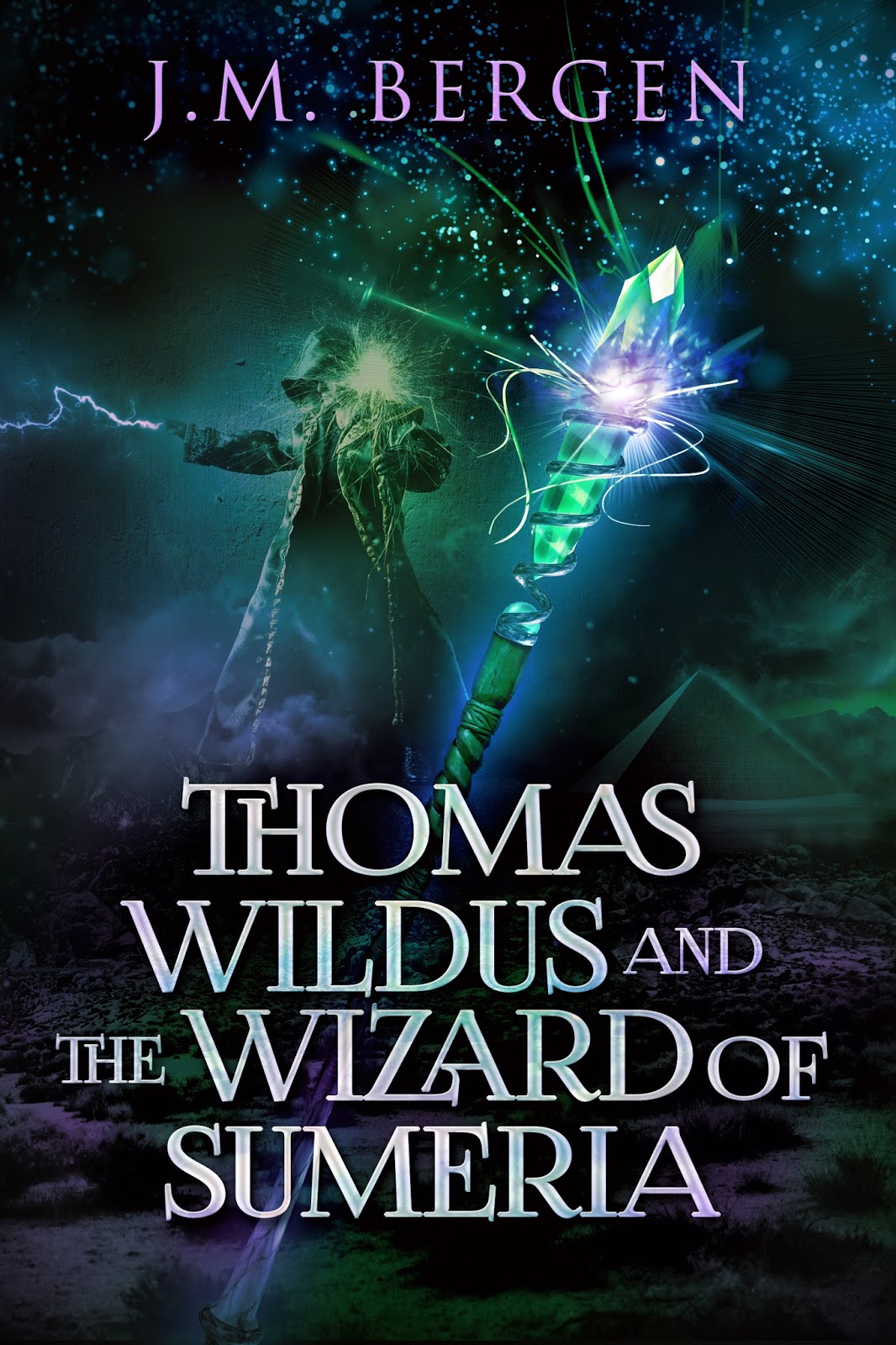
Helping me kick off a new week is novelist J.M. Bergen. He’s chatting with me about his new middle-grade fantasy, Thomas Wildus and the Wizard of Sumeria.

Bio:
J.M.’s debut fantasy/magic series originally started as a bedtime story for his oldest son. The story turned into a saga, and one book turned into five. Thomas Wildus and The Book of Sorrows was released in February, 2019. The book won the Feathered Quill Book Award, a Readers’ Favorite Book Award, and was an award winning finalist in both the American Book Festival and the Red City Review Book Awards.

When J.M. isn’t working on the Thomas Wildus books, you can find him playing with his kids, napping, or dreaming up new adventures. If you ever meet him and can’t think of anything to talk about, you might ask about Herman the Shark, the Kai and Eli stories, or why Riddle-Master by Patricia McKillip is his all-time favorite book. Or maybe you’ll have questions and stories of your own - if you do, he’ll think that’s far more interesting.

Please tell us about your current release.
In the first book in this series, Thomas Wildus discovered a secret family legacy of magic and began to unlock his extraordinary abilities, all while racing to prevent a ruthless billionaire-magician from securing the ability to control - or destroy - the world.

The adventure resumes when a surprise message from a mysterious hacker lets Thomas and his friends know that the fight isn’t over. To the contrary, it seems that their nemesis is after an even more powerful magical object than before, and this time he’s gathering the forces of darkness to his side. Deceptions abound, new characters come into play, and the stakes are nothing short of the fate of the world. It’s a wild ride!

What inspired you to write this book?
The entire series was inspired by bedtime stories, and it was clear relatively early that it was going to take a relatively long series to cover the entire journey (there are a total of 5 books planned in the main series).


Excerpt from Thomas Wildus and the Wizard of Sumeria:
“Hey, what’s that about?” Thomas stepped into the lab and stared at the panel of monitors.

“What’s what about?” Akhil pushed past and glanced at the bank of monitors that covered the far wall. Every screen had gone blank except for a single row of huge white letters running across the center.

The STAFF is REAL, NERDLINGS. Find it, or he will. TIME IS RUNNING OUT.

“What the—?” Akhil stared at the center screen in the large display.

“That’s not right.” Enrique crossed his arms and stared slantwise at the monitor.

“I don’t understand.” Akhil jumped into his chair and punched commands into the keyboard. “This network is built to the same standard as an NSA data center. This shouldn’t be possible.”

Enrique looked at the screen. “I don’t know what should or shouldn’t be possible, but someone did that and it prob- ably wasn’t your dad.”

“My dad is flying home from a conference in Switzerland.” Akhil continued to type furiously. “He’s been on a plane for the past six hours. There’s no way this was him.”

Perplexed, Thomas stared at the message. “I’m less worried about the hacking than the message. What staff? And who is this ‘he’?”

“Arius?” Enrique looked from the message to Thomas, his greenish eyes suddenly concerned. “Who else could it be?”

A shiver ran up Thomas’s spine. Just a few months earlier, Arius Strong and his followers had nearly recovered a crystal that would have given Arius extraordinary power and put the entire world in jeopardy. Arius’s quest had ended in Sumidero Canyon, with a battle that destroyed the crystal and left two of Thomas’s mentors seriously injured. Scott Alpheus had taken Arius’s sight as punishment, but the enigmatic billionaire was still a formidable enemy.

Akhil tapped another button. The words on the screen disappeared and were replaced with the typical interface and command prompt. Clearly annoyed, he pushed his chair back. “Why would someone who has the skills to break into a system like this bother to send a message like that? I don’t get it.”


What exciting story are you working on next?
Thomas Wildus and the Shadow of Elandria isn’t scheduled for publication until next summer, but already it’s shaping up to be quite an adventure!

We recently put out a short prequel to the series as well - The First Crystal – which can be purchased on Amazon but is available for free for your readers if they follow the link.

When did you first consider yourself a writer?
I was a creative writing major in college, and even though I had a few poems picked up in anthologies, I didn’t feel like a ‘real’ writer until my first full-length book was finished and on the market.

Do you write full-time? If so, what's your work day like? If not, what do you do other than write and how do you find time to write?
My morning typically starts with some combination of meditation, martial arts, and writing, and I tend to write until either I run out of steam or one of my kids needs help with something. The rest of the day varies quite a lot, but typically includes a bit of creative work and a bit of practical ‘getting things done’ type stuff.

What would you say is your interesting writing quirk?
When I first started writing the tendency to overthink and over-edit was so overwhelming that I sometimes forced myself to write with my eyes closed. I still do that from time to time, and it still helps get the inner critic out of the way.

As a child, what did you want to be when you grew up?
If you’d asked me as a ten year old I’d have probably said baseball player, but writer would have been right in the neighborhood as well. Today, writer tops the list, and I’d love to do some work with the film and television industry.

Anything additional you want to share with the readers?
Just how much I value and appreciate their support. Writing is something I’d gladly do for free (and have, for a good part of my life), and being able to share my work with people who enjoy and appreciate it is literally a dream come true. It brightens my day every time someone recommends Thomas Wildus to a friend, or leaves a positive review, or tells me how much they or their kids enjoyed one of the books. The critical feedback has been helpful as well, and I feel like my readers are responsible for a large part of my growth.

Links:

Tuesday, April 14, 2020

Interview with novelist Kathryn Schleich

My special guest today is writer Kathryn Schleich. She’s chatting with me about her new crime thriller, Salvation Station.

Bio:
Kathryn Schleich has been a writer for thirty years. Her most recent publications include the short story “Reckless Acts,” featured in After Effects: A Zimbell House Anthology, and her story “Grand Slam,” published in The Acentos Review in May 2017. She is the author of two editions of the book Hollywood and Catholic Women: Virgins, Whores, Mothers, and Other Images, which evolved from her master’s thesis. Her guest posts have been featured on the Women On Writing blog, The Muffin, and she writes for the Amherst H. Wilder Foundation’s volunteer newsletter. When she’s not writing, Schleich is likely volunteering in the education and arts communities in the Twin Cities, where she lives. Friends, family, good food, wine, and traveling are important aspects of her life. Salvation Station is her first novel.

Welcome, Kathryn. Please tell us about your current release.
Salvation Station is a crime thriller published by She Writes Press.

Synopsis:
When committed female police captain Linda Turner, haunted by the murders of two small children and their pastor father, becomes obsessed with solving the harrowing case, she finds herself wrapped up in a mission to expose a fraudulent religious organization and an unrepentant killer.

Despite her years of experience investigating homicides for the force, Captain Linda Turner is haunted by the murders of the Hansen family. The two small children, clothed in tattered Disney pajamas, were buried with their father, a pastor, in the flower garden behind a church parsonage in Lincoln, Nebraska. But Mrs. Hansen is nowhere to be found—and neither is the killer.

In St. Louis, the televangelist Ray Williams is about to lose his show—until one of his regular attendees approaches him with an idea that will help him save it. Despite his initial misgivings, Ray agrees to give it a try. He can’t deny his attraction to this woman, and besides, she’d assured him the plan is just—God gave her the instructions in a dream.

Multiple story lines entwine throughout this compelling mystery, delving into the topics of murder, religious faith, and the inherent dangers in blindly accepting faith as truth. While Reverend Williams is swept up in his newfound success and plans for his wedding, Captain Turner can only hope that she and her team will catch the Hansens’ cunning killer—before more bodies surface.

Praise:

“Salvation Station is your next must-read mystery. Kathryn Schleich perfectly blends together a taut tale of murder in the church. A devilishly good tale.” —CARA LOCKWOOD, USA Today best-selling author of I Do (But I Don’t)

“Salvation Station is an edge-of-your-seat, page-turning thriller that might possibly leave you unable to sleep. This book is what we need in the world right now—a killer we can hate and a model cop we can get behind, showing us that women are as fierce as men and then some.” —MARGO DILL, Managing Editor, WOW! Women On Writing


What inspired you to write this book?
Two specific instances inspired Salvation Station. First, I worked with law enforcement trying to solve a suspicious death in my family (unfortunately we didn’t, too much time had lapsed). But I was fascinated with how the police actually work. And second, I was married to a Catholic deacon over 20 years. During that time, I witnessed first-hand a very dark side to religion. I’m not just speaking about hypocrisy among the ‘faithful’, but the often disturbing elements of lying, fraud, and taking advantage of others. Add to that the sex abuse scandal within Church. Other faiths have sexual outrages, but generally other religions are not the immense hierarchy the Catholic Church is and don’t merit the same amount of attention. What all these examples have in common I think is the inconceivable breach of trust, a major theme in the book.


Excerpt from Salvation Station:
His voice was as smooth as good Kentucky sipping whiskey, the southern lilt forceful yet refined. Among the crowd, a few responded, “Amen!” as the Reverend Ray Williams, his body six foot three inches of sinewy muscle, strode across the cramped stage on a mission to save and assessed his sparse flock. The set was tightly confined; on TV, the lighting, color, and camera angles would give the illusion of spaciousness.

“Remember what the Bible tells us in John, chapter eight, verse twelve. Jesus proclaims, ‘I am the light of the world! Whoever follows Me will never walk in darkness but will have the light of life!’ Believe in Him and I tell you, brothers and sisters, all who accept Jesus Christ will have everlasting life!”

Rev. Ray had done this work long enough to know everything looked better on television, except the numbers. For five years, he’d courted an audience from a low-power cable TV station in St. Louis, confident his message would attract followers looking for salvation. A couple thousand worshippers invited The Road to Calvary into their homes, but it wasn’t enough. He had spent more of his own money than he cared to admit; however, expenses kept rising, and there was relentless competition for viewers, members, and revenue.

Even now, Ray was conflicted in his decision to close what had seemed a promising venture. He’d never lost his enthusiasm or the feeling he was indeed proclaiming the word of God and news of salvation. Ray knew everyone was a sinner, including himself. He hoped The Road to Calvary would spur people to rise above their sins, accept the Good News, and find the true meaning of Christ in their lives. The reverend smiled warmly at his audience and motioned for them to stand. “Let us share our belief in Jesus Christ by praying together our prayer of deliverance.”

The congregation rose to their feet and repeated the words they had come to know by heart: “Lord Jesus, I believe in You. I believe You died for my sins and rose again to save me from a world mired in sin . . .”

At the prayer’s end, a cheerful male voice yelled off stage left, “That’s a wrap!”

The prayerful opened their eyes. Ray bid his flock goodbye. “Thank you for joining us, and see you next week for another taping.”


What exciting story are you working on next?
Currently, I have two short stories I’m seeking to publish. Later in 2020 or early 2021 I will rerelease Shades of Darkness, Shades of Grace, a novel which I published in 2008 under a pen name. It’s primarily a domestic thriller based on true events. The reviews have been so positive that I decided to relaunch the book for a larger audience. Lastly, I’m half-way through writing a mystery set in a rural college town.

When did you first consider yourself a writer?
I really considered myself a writer when I wrote my master’s thesis in the early 1990s on the image of Catholic women in Hollywood films. That evolved into my first book, Hollywood and Catholic Women: Virgins, Whores, Mothers, and Other Images. It’s essentially a college textbook which has been used around the country.

Do you write full-time? If so, what's your work day like? If not, what do you do other than write and how do you find time to write?
I have a chronic illness, so often it depends on how I’m feeling. My goal is to write every day, but it’s not just my own pieces I work on. I’m very involved in volunteering with a local foundation (the Amherst H. Wilder Foundation in St. Paul, Minnesota) and I do quite a bit of writing articles on their programs and amazing volunteers for their newsletter and/or website. I also have my blog and other volunteer activities. 

What would you say is your interesting writing quirk?
I have to be by myself, with no noise or other distractions. When I see people happily writing away on their laptop in a coffee shop, I can’t for the life of me figure out how they do it.

As a child, what did you want to be when you grew up?
A nurse, like my mom, Louise. There was only one problem – I couldn’t stand the sight of blood!

Anything additional you want to share with the readers?
Thank you so much for featuring me on your blog, Lisa!

Links:

Friday, June 14, 2019

Interview with debut mystery novelist Gregory Sterner


Debut mystery author Gregory Sterner joins me today to chat about his suspense novel Solving Cadence Moore.

Bio:
Gregory Sterner is inspired by the great storytelling presentations of National Public Radio, including This American Life and Wiretap, as well as novels by Stephen King, Elmore Leonard, and many others. He earned a bachelor’s degree in Business Administration from Albright College and is currently completing his Master’s in Philosophy at West Chester University while working as a supervisor for Penske Truck Leasing. He lives with his wife Abigail in Reading, Pennsylvania, and has four children: Jordan, Austin, Alexis, and Jack. His debut novel Solving Cadence Moore was released on November 7th, 2017. It is available for sale on Amazon, Barnes & Noble, and other retailers. Readers can connect with Gregory on Facebook and Goodreads. To learn more, go to http://www.aperturepress.net/books/solving-cadence-moore/

Welcome, Gregory. Please tell us about your current release.
My debut novel is Solving Cadence Moore, a mystery novel about a ten-year-old cold case. Cadence Moore was a famous young singer who disappeared without a trace in western Pennsylvania in 2002, never to be seen again. The case has recently been brought back to prominence by a smash hit documentary that has played fast and loose with the facts and many die-hard followers of the case believe the mystery remains unsolved. Public radio juggernaut UPR produces a podcast series and live midnight special to capitalize on the notoriety of the documentary and brash conspiracy radio host Charlie Marx is the unlikely choice to host the series. Charlie comes up empty in his efforts to solve the mystery until he starts taking crazy risks and telling big lies all in the pursuit of getting live on air with the long elusive truth. Readers will ride a roller coaster of suspense on their way to finding out if the real truth of Cadence Moore is finally revealed or whether Charlie Marx’s career will go down in flames live on air.

After a very long process of writing, editing, pitching, and re-writing, the book was published by Aperture Press, LLC (the realization of a life-long dream for me) and is now available at Amazon and all other major online retailers.

What inspired you to write this book?
I was attempting to write what was (in my mind) a horror novel about a girl who disappeared ten years ago and the haunting memories which torture her old boyfriend. I quickly realized I was not a horror writer and this book was not working. I kept turning the story around in my mind, trying to figure out a way to bring it to the page in a believable way. This was years before I completed the book. I was exposed to Ira Glass’s show This American Life on NPR. The way he broke down stories into “acts” and did a slow reveal on crucial facts made me realize that my own story could be told in the same way a “radio play” was put together. As I was deeply into the writing process and even as I pitched my first draft of the novel to publishers and agents, the podcast Serial became a super-successful hit. As I re-wrote my novel (initially incorporating my eventual publisher’s structural changes) I decided a topical change was needed and the podcast series and live radio special structure was introduced into my existing story and everything really came together at that point.


Excerpt from Solving Cadence Moore:
Chapter 1 – The Pitch
Charlie Marx sat with his arms crossed, refusing to visually sell his reaction to the sales pitch he was getting. As a successful conspiracy radio show host, Charlie had learned to trust nothing but consider everything, qualities which had made him very effective throughout his career.

His boss (as well as his mentor and friend), Tyler Reubens, had been in the public radio game for fifteen years, becoming a national celebrity by hosting a hugely successful syndicated show covering everything from intimate personal stories to murder mysteries called United Way of Life. Tyler, while still sitting at the helm of United Way of Life, was also now a big player at the executive level as a senior producer for WHHW (his home station) and programming liaison to UPR (the public radio juggernaut of which WHHW was an affiliate).

Tyler’s superiors were looking for on-demand content for various multimedia outlets (a trend the entire entertainment world had already been moving strongly toward for five years and public radio had been one of the first to plant a flag in podcast land, but had never had a smash hit). Tyler was reaching out to the one person who in his mind had the one show he was almost positive would connect with a large audience for the podcast mini-series UPR was prepared to push to the moon (or so went Tyler’s initial sales pitch).

The one man with the one show also happened to be a personal protégé of Tyler Reubens himself, Charlie Marx. Charlie was a former college DJ and conspiracy newsletter writer. Tyler had plucked him from obscurity and offered him an assistant producer job for United Way of Life, simply because he liked his work and was impressed by the buzz Charlie had managed to drum up for his conspiracy rag. Charlie produced a few conspiracy oriented segments for United Way of Life during anniversary years of the Kennedy Assassination and the Apollo Moon Landing. These segments had garnered such positive reviews that Tyler lobbied for Marx to be granted his own time slot on WHHW with a conspiracy-themed show called Underground BroadcastUnderground Broadcast eventually became one of the most popular programs on WHHW and had been considered at least on two occasions for national syndication over UPR stations, although that had never actually come to fruition.


What exciting story are you working on next?
I have two big irons in the fire, both of which I’m about 20% through at this point.

The first book (working title: Tomorrow in Twenty-Nine Palms) is about a dying man who in his last act hands a small leather bound book to a total stranger as he utters his dying words, “It has to be you.” The total stranger is Jack Hayes, a lying con man looking for his next angle in life. He soon finds himself embroiled in an unbelievable situation, and before the night is over, dangerous men who want the book back are chasing him all over town. All roads eventually will lead to Twenty-Nine Palms, CA and the secrets that may be found there.

The second book (working title: The Gallem City Limits) is about a charismatic young man who has worked his way into amassing a large number of troubled young people into his circle and indoctrinating them into his philosophy of life, which revolves around “balance” at all costs. Before long, he and his followers will balance the karma of long-ago atrocities (the mass scapegoating murders in Gallem centuries before is his starting point) by staging current ultra-violent atrocities (only this time with the “good guys” and “bad guys” on different sides). Danny Drake is about to become the most notorious cult leader in America and Gallem is the site of his National emergence.

When did you first consider yourself a writer?
I have been writing since I was a kid, starting with stories of me and my dog having adventures in space. I started my first novel when I was about 22 years old and got about 100 pages through it before I lost all of it due to the floppy disc it was saved on becoming corrupted. I was too foolish at the time to have backed it up so it became a very demoralizing experience. I later decided to try again and just write a story for myself, to make myself laugh, and to show the finished product to my friends. That put some of the joy back into the process. After that, I began tossing around the bare bones of what would become Solving Cadence Moore. I felt, while writing it, that I was a writer. I felt, while pitching it, that I was a writer. But I did not feel like a “real” writer until the publisher agreed to publish the book. It’s sad that many writers feel the need to be validated by someone else saying they will invest in producing our novels for mass consumption to feel like we’re actually legitimate “real” writers but that seems to be the way it is.

Do you write full-time? If so, what's your work day like? If not, what do you do other than write and how do you find time to write?
I became good at balancing family life with a full-time job and college education over the last 10 years. This gave me some perspective on the amount of time someone needs to dedicate to complete something and complete it well, with quality in mind. I have brought the same approach to writing. I feel like a writer has to pick their spots so they do not alienate their family in the process of creating their “masterpiece.” That is my take anyway. It also helps to have an encouraging and understanding wife.

What would you say is your interesting writing quirk?
I seem to really like having characters drink and smoke as they go about their adventures. I think this might be my way of working through not being able to do these things myself, or at least not as much as I’d like to, so I live my former bad habits through my characters. This is a healthier approach than a writer drinking heavily and smoking like a chimney while writing. My advice: write it- don’t do it. You’ll survive longer and write more books!

As a child, what did you want to be when you grew up?
I wanted to be a pro-wrestler my whole childhood. I seemed to ignore the sad fact that I had the athletic ability of a bow-legged kangaroo while I was dreaming this dream. I think what I was really attracted to was the pageantry and presentation of a spectacular story being told in the ring and around the ring. I realized later I could do most of this on the page and then writing became my passion.

Anything additional you want to share with the readers?
I have learned so far in my brief membership in the worldwide club of published authors that it is wise to listen to feedback, especially from publishers or agents who have had more success than you. One has to be flexible and open to collaboration in order to move forward in the process of getting your novel published. I think it's important to embrace inspiration when it comes and don't be afraid to take risks, as long as you do so in the parameters of good writing. It can be easy to push things too far if you don't have in mind what a potential wide readership might enjoy. I'm still learning and feel lucky to have been granted the opportunity to get a novel published.

Links:

Thanks for joining me today!

Monday, February 6, 2017

Interview with writer Jeffrey Konis


Writer Jeffrey Konis joins me today to talk about his new historical fiction / memoir, The Conversations We Never Had.

Bio:
After practicing law for many years, Jeffrey H. Konis left the profession to embark on a career as a high school social studies teacher. His first book, From Courtroom to Classroom: Making a Case for Good Teaching, offers a unique perspective for teachers who seek to inspire their students to learn for the sake of learning.

His latest work, The Conversations We Never Had, is a historical fiction novel / memoir about his relationship with his grandma. It highlights the importance of family history.

Jeffrey loves reading, collecting fine art photography, soccer – especially Liverpool F.C. – travel, and his family most of all. He currently resides in Goshen, New York with his wife, Pamela, and sons, Alexander and Marc.

Welcome, Jeffrey. Please tell us about your current release.
My father, a Holocaust survivor, lost his parents by the time he was nine and remembers virtually nothing about them, including what his father looked like; no pictures of him exist. He was ultimately brought to this country by his mother's younger sister, also a survivor, to raise as her own. My dad never asked, for one reason or another, never asked about his real parents. I had moved in with his aunt, my grandma Ola, and lived with her for over two years. It was not until many years after her death, that I realized that I, too, never asked her the questions my father never asked. The Conversations We Never Had is a chronicle of my time with Grandma Ola and my imagining of the stories she might have shared had I only thought to ask the questions.

What inspired you to write this book?
The inspiration for writing the book, based upon profound regret, stems from the fact that it seemed to be the only way I could answer so many unasked questions, if only in my imagination. I also simply needed to write it for my grandmother, for my father and for myself.


Excerpt from The Conversations We Never Had:
From Chapter 2 – Grandma Ola and Me
Over the following days, I found myself picking up the old routine of going to classes, hitting the library, getting a slice or two for dinner, going home and hibernating in my room. Grandma would occasionally check on me, I think more than anything to make sure it was indeed me and not some wayward stranger. I felt bad not spending more time with Grandma the way I had that night when we talked about her dad, but I guess I was too tired after my long days or unsure how to restart the conversation. I knew Grandma was lonely, lonelier with me around than she would have been alone. Then there was something of a break in my schedule. It was the weekend after Thanksgiving and, caught up with all my work, I decided to spend some time with Grandma and talk. Late Saturday afternoon, after the caregiver had left, I approached her.
"I know it's been awhile but I was wondering whether we could talk some more, if you're up for it, that is."
"Up for it? I've been 'up for it' for the last two weeks. What do you think, that I'll remember these things forever? You think my memory will get better as I get older?"
"I know, I'm sorry. I've been busy with school and . . . ."
"Jeffrey, you barely say hello to me. How many grandmothers do you have anyways? Well?"
Interesting question but, of course, she was right. My maternal grandmother died when my mother was a young girl; I never knew her father, Grandpa Eugene, who died when I was two.
But Grandma Ola said something else that made me stop to think for a second: her memory would surely deteriorate, and in the not-too-distant future. Once that went, so did any chance of learning about my paternal grandparents. There was now a sense of urgency to my mission. Indeed, there were increasing signs that her mind was starting to slip.
The phone had rung, a few nights previously, and I gave Grandma first dibs to pick up the phone to see who it was, as this was pre-caller ID. The phone kept ringing and I looked in on Grandma, who I knew was lying on the couch in her room. The scene upon which I stumbled was humorous, though it should not have been: there was Grandma, holding a pillow to her ear and talking into it, "Hol-low? Hol-low?" I quickly picked up the phone just as my dad was about to hang up. He often called to check on both of us, to make sure that we hadn't yet killed each other, that we were still alive.

What exciting story are you working on next?
I haven't yet given serious consideration to my next work, assuming I have another one in me. My best friend of twenty years, who was more like a brother to me, died when we were in our thirties, leaving a young widow and three-year-old son. I sometimes think about writing of our friendship, our lives and his death. But then I immediately reconsider doing so; writing The Conversations We Never Had was quite painful. I don't know if the effort writing such a story would warrant the inevitable pain. Perhaps if I thought I could use some therapy in connection with his loss, some sixteen years ago (May 9, 2000), I might be more apt to write the book.

When did you first consider yourself a writer?
I considered myself a writer when my father had insisted that, rather than buy birthday cards containing someone else's words, I should make up my own cards with my words. I realized that I was actually pretty good at it. My favorite was a card I had written my dad for Father's Day: I wish you had me younger so I could have you longer.

Do you write full-time? If so, what's your work day like? If not, what do you do other than write and how do you find time to write?
I do not write full-time as I happen to be a high school social studies teacher who practices law on the side when I can. Having a teacher's schedule, i.e., summer's off, has allowed me the time to write. The challenge remains, however, that I must isolate myself from everyone when I write.

What would you say is your interesting writing quirk?
I don't know if I have a writing "quirk" per se but I do write long-hand, typically, in my living room when my wife is out shopping and my two boys are otherwise occupied When writing fiction, I will plop in my favorite chair, waiting to be inspired, for some story to, more or less, drop in my lap. If no such inspiration is forthcoming, which is more likely the case, I will get up to leave and do something else. I will return at some other point and repeat the "process;" I just never know when something will just hit me out of nowhere.

As a child, what did you want to be when you grew up?
When I was little, I dreamt of playing tennis professionally, not that I ever had a chance of ever doing so. It was just the idea of playing tennis for a living, travelling the world and, ultimately, being your own boss at the end of the day sounded simply perfect.

Anything additional you want to share with the readers?
Soccer is my religion; Liverpool Football Club is my faith - no - my belief. Bill Shankly, the godfather of Liverpool FC, once noted how people thought that football, to him, was a matter of life and death. Shankly responded that it was more important than that. Not literally, of course, but I definitely got the point. One more of his favorite quotes that had always very much appealed to me as a fan was, in reference to Liverpool: "If you don't support us when we're losing then don't support us when we're winning." What must be painfully clear by now is that I could on about LFC and soccer but I will, mercifully, spare readers.

Links:

Thanks for being here today, Jeffrey.