Wednesday, May 8, 2019

Interview with memoirist Kavitha Yaga Buggana


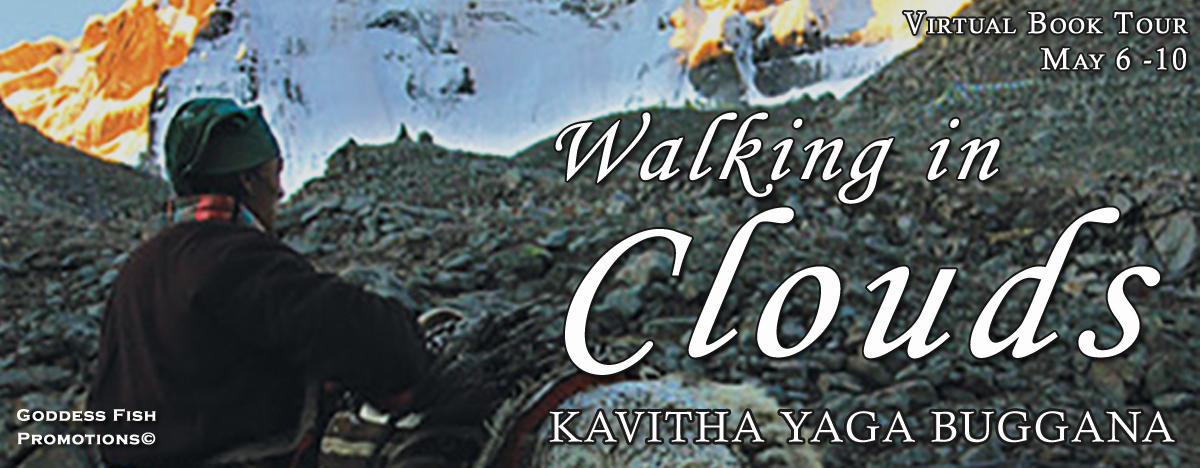
My special guest today is Kavitha Yaga Buggana to chat about her travel memoir, Walking in Clouds, A Journey to Mount Kailash and Lake Manasarovar.

During her virtual book tour, Kavitha will be awarding a $25 Amazon or Barnes and Noble (winner’s choice) gift card to a lucky randomly drawn winner. To be entered for a chance to win, use the form below. To increase your chances of winning, feel free to visit her other tour stops and enter there, too!

Welcome, Kavitha. Please share a little bit about your current release.
My travel-memoir, Walking in Clouds, A Journey to Mount Kailash and Lake Manasarovar, is based on my trip to a mysterious mountain and a beautiful, tranquil lake in Tibet.  It’s a journey spanning ancient monasteries and verdant Himalayan pine forests, freezing slopes and bright sunlight, exhaustion and joy, sacrifice and gratitude.

Kailash and Manasarovar are deeply sacred to Hindus, Buddhists, and others and as an atheist walking in these sacred spaces, I examine my judgements about faith. ‘Walking in Clouds’ is also about people - my cousin, who went on this journey with me, our fellow travellers from the world over. The book examines faith, rationality, myth, Tibet’s deeply troubled politics, the friendships formed, and the extraordinary landscapes of these places.

Interspersed with striking photographs and a rich storytelling style, the book is ultimately a mediation on beauty, faith, friendship, place, and journey, both the outer and inner. 

What inspired you to write this book?
For my cousin Pallu and me, the trip to Kailash and Manasarovar was an adventure we had dreamed of since we were schoolgirls. I had no intention of writing about this journey, but a year after my trip, I started working on a brief account of the journey. The more I wrote, I realized, the more there was to write about the wonder, tranquility and awe-inspiring beauty of the mountains and the enduring faith of the people who live in there. That’s how my book was born.


Excerpt from Walking in Clouds:
In this excerpt of Walking in Clouds, our group has reached the first campsite at the foothills of Mount Kailash. Fellow travelers Sperello and Jeff have both gone further up the slopes while the rest of us are at the campsite with our guide, Chhiring.

A little while later, the tall figure of Sperello descends down the path.
‘Where’s Jeff?’ Chhiring asks.
‘He should be down soon,’ Sperello says, his face pensive. ‘Something happened to Jeff in the mountain.’
When Sperello started up the slope, Jeff had already set out. With each step, Jeff felt that he was moving forward but the mountain was not getting any closer. Another step, Jeff told himself, one more step. But it was no use; the mountain seemed as distant as it had always been. At one point, Jeff stopped; he could not walk any further. As he gazed at the colossus of rock before him, he was shaken by a feeling that the mountain was rising from below, as if it were moving, growing from the earth to the sky. An inexplicable emotion coursed through his body, moving him so profoundly that he fell to his knees. Sperello, who was taking photos in the vicinity, asked if everything was all right. But Jeff could not speak. Still kneeling, he shook Sperello’s hands.
‘I will never forget it,’ Jeff tells us later. He can’t seem to explain what happened to him at that moment.
On his travels, Jeff is always an observer. He is a photographer, a chronicler of journeys, and a consumer of other cultures and geographies. But that day on the mountain, everything changed. The lens was forgotten. The need to observe and the process of thought vanished. Jeff was no longer an eye, watching and noting; he was being and doing and feeling. The same man who, a few days ago, had found it odd and eccentric that Mariene could meditate on the river bank had been overcome by an immensity of emotion that had brought him to his knees. He had been felled by a deeply spiritual experience that belonged only to him, and to the mountain.
The experience altered Jeff’s understanding of the world and of himself. The effect this vision had on him and the questions it raised for him were a profound kind of truth. Since ancient times, mystics of all religions have strived to reconcile their spiritual experiences with the parameters of the physical and material world. Many have come to understand that while reality and truth are not always the same, they do not necessarily oppose or preclude one another. The myths of Shiva, the lake and the mountain, Buddhist stories and visualizations, the feeling of a mountain rising: none of these need be literal in order to be considered truthful. Such moments simply point to a truth as complex as the people who seek to understand them.


What exciting story are you working on next?
I’m working on a book of short stories. They are all set in India, but that’s about the only thread that connects them. The stories range from the light-hearted (such as a story about a young man who wants to buy milk for coffee and finds that everyone is gripped by the possibility of a milk miracle) to the introspective (such as the story of a woman and a talking bird which discusses reality versus perceptions of reality) to the socially sensitive (such as the story of a missing servant girl, which is a commentary on life opportunities and economic circumstances).

When did you first consider yourself a writer?
After I published a couple of essays and short fiction in literary magazines and in newspapers.

Do you write full-time? If so, what's your work day like? If not, what do you do other than write and how do you find time to write?
I don’t work full-time any more. When I’m not writing, I take care of family, I read, I volunteer.

What would you say is your interesting writing quirk?
I keep mussing with my hair when I’m thinking deeply about issues related to writing. At the end of the day, my hair looks like a nest.

As a child, what did you want to be when you grew up?
Pippi Longstocking, the feisty redhead in the popular children’s books by Astrid Lindgren.


Anything additional you want to share with the readers?
Walking in Clouds received some great reviews in the Indian press. Here are some quotes:

‘[Kavitha’s] mix of Oriental-Occidental wisdom can dot the readers’ minds with the spray of sparkling Himalayan stars.’
Aman Nath in Outlook Traveller Magazine, March 2019.

‘This book is the most enjoyable I have read on the Mountain and the Lake.’
Deb Mukharji, Author, Kailash and Manasarovar: A Quest Beyond the Himalaya

‘Walking in Clouds is not only [about] two women's extraordinary journey to the mountains, but rather an account where the author has captured every moment of surprise, shock and despair in detail.’
Priyanka Richi, The Newsminute, 31st March, 2019

Links:

Thank you for being a guest on my blog!
Thanks for having me!


Monday, May 6, 2019

Interview with novelist Robert Sells


I’m happy to be helping novelist Robert Sells kick off a virtual book tour for his new science fiction novel, Revelations.

During his tour, Robert will be awarding a $40 Amazon or Barnes and Noble (winner’s choice) gift card to a lucky randomly drawn winner. To be entered for a chance to win, use the form below. To increase your chances of winning, feel free to visit his other tour stops and enter there, too!

During the tour, the book will be on sale for only $0.99.

Bio:
Robert Sells has taught physics for over forty years, but he has been a storyteller for over half a century, entertaining children, grandchildren, and students. He has written the award-winning novel, Return of the White Deer, historical fiction about Penda of Mercia. His second fiction book, Reap the Whirlwind, was a thriller about the dawn of artificial intelligence and the subsequent decline of humanity. His third book, The Runner and the Robbery, was a young adult novel about a teenager and his grandfather who had Alzheimer’s disease. Revelations, a science fiction novel, is his fourth book.

He lives with his wife, Dale, in the idyllic village of Geneseo, New York with two attentive dogs who are uncritical sounding boards for his new stories. He is intrigued by poker and history, in love with Disney and writing, and amused by religion and politics.

Please share a little bit about your current release.
Well beyond the backyard of our solar system are billions of stars, some of which will harbor intelligence life. This is a story about First Contact, how it actually might happen, possibly in the next few years. Don’t expect large spaceships hovering over New York City or an armada of aliens popping up right above New York City. Instead First Contact will be more mundane, a series of binary numbers, sent across the void, conveying information about an alien world. In my newest novel, Revelations, a secret message is embedded in this first signal from an alien civilization… a secret message that could end human civilization.

What inspired you to write this book?
Science fiction should have its emphasis on science. The future depicted by Star Wars and Star Trek, though exciting, is not based on science. Real journeys between the stars would take years, more likely, centuries and require prohibitively large amounts of energy and resources. It is far more likely that interstellar civilizations will interact through messages sent back and forth. While it would be interesting to receive such a signal, meeting an alien, face-to-face, is far more exciting. Could such a meeting occur through a message? Actually, it is possible and the novel gives a plausible way two species separated by many light years could physically interact with one another.


Excerpt from Revelations:
 

CHAPTER EIGHTEEN


            Aster hefted the semi-automatic rifle. How do these things work, anyway?
A clacking sound, not far off. She broke into another frightened sprint. I’ve never run so far, so fast, so much in all my life. My heart? Will it burst?
A minute later she stopped. Her breath came in large gulps while her muscles screamed with pain. A surge of adrenalin (how much of that hormone do I have?) flowed through her while she scanned the floor for centipedes. My God! I forgot to check for the little bastards, though they are the least of my worries now. Then she saw one. A small one. She stepped on it and ground her boot into the cement. Overhead a gray flier glided by. Aster gripped the barrel of the gun like a bat and waited for an attack. But the gelatinous shape flapped by, ignoring her.
She leaned back against the wall, staring straight ahead, but not seeing anything. The sprint, the fear, the need for constant vigilance had exhausted her. She started shaking uncontrollably. She felt dizzy. Don’t faint, Aster. Not now. She shook her head, forcing herself to be more alert.
Black oblivion tried to wedge itself into her mind, the promise of sleep and forgetfulness. Eyes closed, Aster slipped down on the floor and laid in a fetal position. Blackness began to cover her like a warm blanket. Just rest, for a few seconds, forget all of this. Maybe a short nap.
The monotone world surrounding her disappeared. When I open my eyes, I’ll wake up and the black mist of this frightening dream will evaporate away in the morning sunshine of my wonderful, sunny apartment in New York. She opened her eyes and felt tears seeping into her eyes.
Nothing had changed. The dim light, the straight, smooth, drab walls. The emptiness. The coppery smell of blood, human blood, in the air. Nothing had changed in her mind, either. Go back to sleep, Aster. Back to sleep. She started to close her eyes again. Then she opened them wide, surging to a sitting position. No sounds. In fact, an unsettling silence had taken over the Dome. My God. Is it over?
She sighed and peered down the dim alley to the right and left. If they are done with the soldiers, they will be looking for me. Keep moving. Keep alert. Keep alive. Quelling her dizziness as she returned to an upright position, the astrophysicist resumed her trek, walking, not running. Searching the floor for centipedes, listening for sounds, and moving away from monsters.
The lighting was dim, but not dark. Thank God. Light enough to see monsters though, that’s for sure. Narrow alleys leading into other narrow alleys, none straight, turns every three hundred feet. She was lost, hopelessly lost. She grunted. Maybe that was a good thing. Maybe being lost had saved her.
Reaching in her pocket, Aster grabbed a compass. The expedition began at the southern gate so she knew going south was her salvation. The compass needle pointed one way and when she walked a few steps, it rotated to another direction. Useless. She knew better than to hope for a compass to work. The plasma of a nuclear reactor would have to be contained by a powerful magnetic field. This internal magnetic field swamped the earth’s magnetic field.
Cell phone GPS was useless as well. But it could still tell time. She checked it. Less than half an hour had passed since she last checked the time when she went to retrieve cautious Bob Demarco before the battle. God! It seemed like hours!
While Aster’s body was near collapse, her mind continued its ruminations like a mouse on a treadmill. Fear takes away energy. Interesting. She grunted. Interesting that you still think analytically, you idiot. Her eyes snapped back to the floor. No centipedes. Okay, rest a bit. Don’t exhaust yourself, girl. Aster slid down on the floor again and covered her face with her hands. We never should have entered this damned place. Stupid, stupid, stupid. The Dome had sent them one subtle warning after another and, like so many other clues, they ignored them. Humans, she reflected, were particularly adept at twenty-twenty hindsight. Her eyes snapped open and wide-eyed, searched the area close to her. She scooted back up. Any of those damn centipedes around? None. She was safe. At least from those creepy, crawly things.
Then a clacking sound. Those horrible feet, ending with hooves, not feet, the tapping sound on cement. She let out a gurgle of hysterical laughter. Here come the bad guys again! She pinched herself hard to try to get control and took a shaky breath. Don’t lose it now. You’ve made it this far. She got up and moved lightly along the wall and, at the junction, steered away from the clacks. Don’t know where in hell I am. She hummed lightly under her breath, repeating it several times, then giggled. No, but I do know that I’m in Hell, don’t I? How about that, Daddy? You were right all along. Your scientist daughter is rotting in Hell, just like you said I would.
She walked for about an hour, winding her way through the corridors, hugging a wall and trying not to be seen, carefully stepping over the gray cauliflower-fungi peppering the ground. Always steering away from those clacking sounds. Looking for centipedes and either killing them or walking away from the larger ones. They didn’t seem to have eyes, but somehow the centipedes could detect her. Smell? Sound?
Finally, bowing to her fatigue, Aster Worthington, famed astronomer, sagged down and sat with her knees pulled up to her chest. She just couldn’t go any farther. Exhausted, all she could do was keep watching left and right.
If they came down the corridor, she probably couldn’t outrun them but maybe she might get lucky with a shot. She knew she had to hit the head. Of course, it would help if she knew how to work the damn gun. She fiddled with a latch around the trigger. Was this the safety? Off. On. Off? On? Off? She didn’t know how long she had been playing with the gun when she was jerked out of her reverie by a sound.
Instantly, standing up, her head snapped around toward the corner of the alley, and she tightly gripped her gun. Alert. A new sound. Padding sounds. What the hell was that?


What exciting story are you working on next?
A romance murder mystery, Rebecca’s Romances. A teenage girl is traumatized by the murder of her best friend. She leaves her hometown to attend college. Twelve years later she returns. Another murder, identical to her friend’s murder, has just occurred. She and three friends hunt for the killer. As the investigation deepens, she becomes certain one of her friends is, in fact, the killer. But, which one?

When did you first consider yourself a writer? While teaching physics, I would sometimes write humorous stories about students engaging the world and discovering or using physics principles.

Do you write full-time? If so, what's your work day like? If not, what do you do other than write and how do you find time to write?
I write about two hours a day on my novels. Early morning, well before dawn, is an ideal time to write. No distractions and all thoughts are viable before the sun rises. I spend another two hours a day writing a political blog about the present administration (I’m worried that President Trump is hurting us far more than helping us). The remainder of time is spent taking full advantage of my retirement from taking care of my health to taking trips to exotic or historic places.

What would you say is your interesting writing quirk?
I’m not a trained writer. I majored in physics and was far more comfortable with numbers than with words. When I write, the whole story comes out in the span of a few days. Then, it takes months to edit the story, tear it apart and build it back up, bring in characters and kill some off, refine the writing, and finally come up with a smooth story that my readers can fully enjoy. I usually rewrite (edit) a story over twenty times.

As a child, what did you want to be when you grew up?
A teacher. But, a teacher of history! After my first history course in college, I changed my major to mathematics. I was sure I was going to be a math teacher. It wasn’t until my junior year in college that I realized my love was physics. We’ve been married for over 40 years now.

Anything additional you want to share with the readers?
In retirement my wife and I watch old shows we never had time to watch while working and raising kids. Now, we enjoy such shows as West Wing, Boston Legal, and Friday Night Lights. But, you have to kiss a few frogs along the way. So, our rule is that we have to give a series three installments before we give it the boot. In a similar way, every book you start to read should be given 50 pages before you discard it.

Links:

Thank you for being a guest on my blog!

a Rafflecopter giveaway


Thursday, May 2, 2019

New interview with mystery author Peter Rowlands


A big welcome back to mystery author Peter Rowlands. We’re catching up today and chatting about his newest thriller novel, The Concrete Ceiling.

Peter was a guest when he debuted his first novel. You can read that interview here.

Bio:
Peter Rowlands has published five mystery thrillers. The first, Alternative Outcome, has attracted over a hundred positive reader reviews worldwide, and has been compared in style and content to the Cormoran Strike series by Robert Galbraith (the pen-name of JK Rowling). According to Peter, “The most flattering review I’ve ever received for any of my books is from a reader who said she wished the story would go on forever.”

Peter was born in Newcastle upon Tyne in north-east England, but has spent most of his adult life in London, and has travelled widely in Europe and America. His mysteries tend to feature ordinary people thrust into challenging situations, and they usually have a strong romantic thread. “But they’re by no means romances as such,” he says. “My characters have their feet firmly on the ground.”

For many years Peter published, edited and contributed to UK business magazines. He was one of the first editors to cover the mechanics of home shopping deliveries during the e-commerce revolution. “I haven’t featured that theme in my books yet,” he comments, “but watch this space!”

Welcome back to Reviews and Interviews, Peter, what inspired you to write this book?
That’s an easy question to answer. For my own writing I chose the self-publishing route, and I quickly learned just how difficult it is it get noticed in such a crowded market. So in The Concrete Ceiling I decided to build a plot round the challenge faced by writers like me. The leading character has self-published his own mystery thriller, and he pays a book promotion specialist much more than he can afford to get it some exposure. Things start to go very wrong from there. His love life is pulling him in several directions at once, and he’s accused of a serious crime he didn’t commit. And he hasn’t even sold any more books!


Excerpt from chapter 16 of The Concrete Ceiling:
Mike meets the book promoter

I took the Tube to Angel station, then set off on foot along Upper Street, the broad bustling heart of Islington’s commercial centre.
The walk took fifteen minutes. As I arrived at the short flight of steps up to the front door it was snatched open and a girl appeared. She had shortish dark hair and a slightly shiny complexion, and looked about fifteen, but could have been younger. She was wearing studiedly scruffy jeans with splits and tears at the knees, and was tapping urgently on a mobile phone. The white wires from her ear buds dangled over her shoulders. She slammed the door behind her, then glanced at me and gave me a hostile stare. “What are you looking at?” The accent sounded American.
“Nothing. I’m trying to find Rob Openshaw. Is this the right place?”
“Who wants to know?”
“My name is Mike.”
“Is that right?” She continued to stare malevolently at me. I tried to meet her gaze without flinching, and after a moment she said, “Right.” She turned back to the house, gave an exaggerated press on the large bell push, then swivelled round and trotted down the steps. “Knock yourself out, Mike.” She gave my name sarcastic emphasis. She almost barged against me as she headed off airily down the street.
There was a long pause, then the door opened again and a man looked out warily at me. He was slim in build and quite tall, and had a narrow face and soft mid-brown hair. His black jeans and smart loose-fitting grey linen jacket gave him a youthful aura that probably belied his age.
“Can I help you?”
“Rob Openshaw? I’m here about The Magic Bookseller.”
“What?” He stared at me with what I could only read as shock. After a moment he said, “Who are you?”
“I’m a client – an author. I’m wondering when my promotional campaign is going to run.”
“A client?” He continued to stare at me as if he could scarcely comprehend what I was saying. Finally he shook his head. “Look, I’m sorry you’ve wasted your trip, but this isn’t an office. We don’t meet clients here. We’re a virtual operation …”
I could almost hear the thought processes whirring in his head. He wanted to close the door on the conversation, but he could see that this wouldn’t make me disappear, or prevent me from knowing where he lived.
Before he could come to any conclusion I said, “All I want to know is when my campaign is going to start. I’ve paid up-front and you’ve had my money, but I haven’t seen any evidence of any promotional activity.”
He was shaking his head. “How on earth did you find me here? We don’t publish a UK address. We operate from California.”
“I know that, but you don’t answer messages, so what else was I to do?”
“All the same …” Abruptly he switched to another tack. “Can I ask who you are?”
“My name is Mike Stanhope.


What’s the next writing project?
I have two possible ideas – another book in the series about Mike Stanhope, in which he finds himself doing some genuine detecting, and a stand-alone thriller about a man who thinks he’s bumped into his ideal woman in a shopping mall. I haven’t decided yet which I’ll work on first.

What is your biggest challenge when writing a new book?
I guess the biggest challenge for me with every book is sorting out the detail of the plot. I don’t mind coincidences in stories, but I hate implausible developments, or people acting out of character, so I spend ages checking that whatever happens, it seems convincing and believable, and fits in logically with everything that comes before and after.

If your novels require research – please talk about the process. Do you do the research first and then write, while you’re writing, after the novel is complete and you need to fill in the gaps?
I try to write within areas that I already know, so mostly I only have to brush up my knowledge, not start from scratch. If there are key plot points that I’m not familiar with (a type of injury, for instance), I research it before building the plot round it, but if it’s more of an incidental point (US visa requirements, for instance), I sometimes just check the details when the issue arises.

What’s your writing space like? Do you have a particular spot to write where the muse is more active? Please tell us about it.
I usually work in the south-facing front room of my apartment, which often has lots of sunlight to give me a positive outlook. But so long as I’m in front of my keyboard, I’m happy. I connect my laptop to a big monitor with a really clear resolution, and use an add-on keyboard with laptop-type keys that have a nice springiness to them. I find that details like this really can help speed up the writing process.

What authors do you enjoy reading within or outside of your genre?
I love CJ Box’s series about Joe Pickett, the game warden in Wyoming, and I’ve become an even bigger fan of Paul Doiron, who also writes about a game warden, but in New England. Recently I’ve become a particular fan of the Strike series by JK Rowling (writing as Robert Galbraith), which features a downbeat private eye working in central London. My all-time favourite thriller writer was Dick Francis in his prime. I love his confident, economical prose.

Anything additional you want to share with the readers today?
Mike, the leading character in my new book, is right about the challenges facing self-published authors. It can be a hard and lonely road. What we writers crave most (apart from sales!) is reviews – even if they’re just a line long. They really do help attract other readers … as well as giving us a sense of validation! Another challenge is deciding whether books should form part of a series or be stand-alone. I’ve mostly chosen the series approach (except for my fourth book, Never Going to Happen, which I wrote under the pen-name Anders Teller). But I try to make each book work as a self-contained story, so that it doesn’t matter if you don’t know the history. It’s a constant juggling act!

Thank you for coming back to Reviews and Interviews!

Wednesday, May 1, 2019

Interview with novelist Natasha Deen


Novelist Natasha Deen is here today to chat with me about her contemporary YA, In the Key of Nira Ghani.

Bio:
Award-winning author Natasha Deen writes for kids, teens, and adults. When she’s not writing, she enjoys visiting schools, libraries and other organizations to help people to find and tell the stories that live inside of them. She also spends an inordinate amount of time trying to convince her pets that she’s the boss of the house. Her latest novel, In the Key of Nira Ghani, is a Junior Library Guild selection, and a Barnes and Noble Top 25 Most Anticipated Own Voices novel, and an Indigo Teens Most Anticipated Teen Book.

Welcome, Natasha. Please tell us about your current release.
Nira Ghani has always dreamed of becoming a musician. Her Guyanese parents, however, have big plans for her to become a scientist or doctor. Nira’s grandmother and her best friend, Emily, are the only people who seem to truly understand her desire to establish an identity outside of the one imposed on Nira by her parents. When auditions for jazz band are announced, Nira realizes it’s now or never to convince her parents that she deserves a chance to pursue her passion.

As if fighting with her parents weren’t bad enough, Nira finds herself navigating a new friendship dynamic when her crush, Noah, and notorious mean-girl, McKenzie “Mac,” take a sudden interest in her and Emily, inserting themselves into the fold. So, too, does Nira’s much cooler (and very competitive) cousin Farah. Is she trying to wiggle her way into the new group to get closer to Noah? Is McKenzie trying to steal Emily’s attention away from her? As Farah and Noah grow closer and Emily begins to pull away, Nira’s trusted trumpet “George” remains her constant, offering her an escape from family and school drama.

But it isn’t until Nira takes a step back that she realizes she’s not the only one struggling to find her place in the world. As painful truths about her family are revealed, Nira learns to accept people for who they are and to open herself in ways she never thought possible.

A relatable and timely contemporary, coming-of age story, In the Key of Nira Ghani explores the social and cultural struggles of a teen in an immigrant household.

What inspired you to write this book?
Weirdly enough, Nira’s story began as someone else’s. Back in 2014-ish, I was working on a middle-grade novel that would **not** cooperate (translation, a year-and-a-half of me weeping, wailing, and stuffing cupcakes).

After a while, I realized the story I was trying to create didn’t match to the character. He had a different voice and a different tale to tell.

But I couldn’t get the first line out of my head, “The cow’s eyeball floats in the formaldehyde. It’s disembodied, a part cut off from the whole, just like me, but there’s a difference between me and the cloudy orb. It stares out at the kids as though it knows the secret the rest of us are dying to find out.”

So, one day, I took a breath and instead of trying to force the words, I listened for them. It was then I heard Nira’s voice, her longing, her humour, and it took off from there.


Excerpt from In the Key of Nira Ghani:
“Something happened at school?” Mom grasps the half-baked roti between her fingers and flips the dough to its uncooked side. “Is it your grades?”

“No.” Not true. Something seismic happened at school. I decided to try out for jazz band. It happened when I was clinging to the rope, wishing I’d been gifted with upper body strength. Maybe it was the oxygen deprivation, maybe it was the humiliation of knowing everyone was staring and judging. Doesn’t matter. What does matter is jazz band. I’m good with a trumpet. Great with it. The sound of a trumpet is the sound of my soul. Every time I play, it’s like I’m communing with the molecules and atoms that make me, me. Maybe, if I play long enough, loud enough, good enough, my DNA will rearrange itself, and I’ll figure out how to be smart, popular, and worthy.

Getting into band might be a way to get all that and more. The only downside is I need Mom and Dad’s permission. I have a better chance of scaling Mount Everest in a bikini and flip-flops.


What exciting story are you working on next?
Right now, I’m actually taking a break and catching up on the reading, with an eye to doing another young adult novel.

When did you first consider yourself a writer?
I’ll echo a quote from Agatha Christie, who said, “There was a moment when I changed from an amateur to a professional. I assumed the burden of a profession, which is to write even when you don't want to, don't much like what you're writing, and aren't writing particularly well.”

Do you write full-time? If so, what's your work day like? If not, what do you do other than write and how do you find time to write?
I consider myself immensely lucky to be able to write full time. My day starts around 5 AM with a mochaccino, reading, and snuggles with the fur babies. I ease into the day with emails/admin, take a break to walk our sweet pupper, then it’s home. I’ll work on edits, manuscripts, research through the day, (aided with cupcakes and tea), then shut down around 6 PM.

What would you say is your interesting writing quirk?
My firm belief that any story problem can be solved with a good cup of tea.

As a child, what did you want to be when you grew up?
A superhero!

Anything additional you want to share with the readers?
To the readers, thank you. Thank you for sharing your day and your time with me. I appreciate it.

Links:

Lisa, thank you for sharing your blog and thank you for the chance to chat with your readers.

You’re quite welcome. Thanks for being here today!